Myth, checked
One 1932 Cartoon Invented the Great Wall Space Myth
Robert Ripley called the Wall 'the only one visible from the Moon' in a 1932 cartoon. Most missions are in Low Earth Orbit, just a few hundred kilometers up.
The Ultimate Landmark
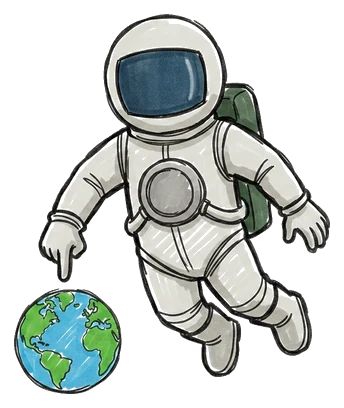
It’s the one fact about it everyone knows. A line drawn across the planet, so big it’s visible from the stars.
It’s presented as the ultimate proof of human achievement. The one thing we’ve built that you could point to from a spaceship, with your own two eyes.
A landmark for the whole planet. It feels like it just has to be true.
And almost every astronaut who has been there will tell you the same thing. They can’t see it.
An astronaut's view from space isn't from some god-like distance. Most missions are in Low Earth Orbit, just a few hundred kilometers up. It’s like flying from London to Paris, but vertically.
From there, astronauts say finding the Great Wall is next to impossible. You need perfect weather, with the sun at a low angle to cast shadows. And you need to know exactly where to look.
An Astronaut's View
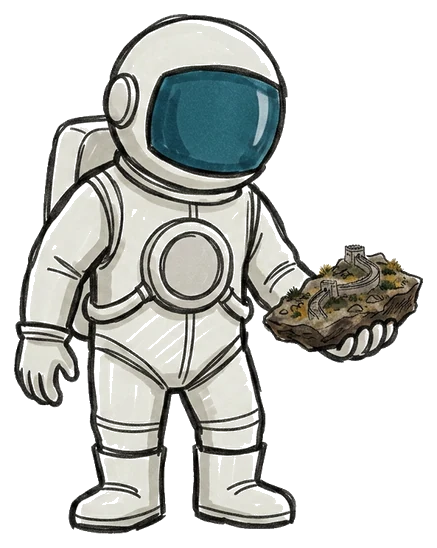
Astronauts looking for the Great Wall of China face a tough search. Even if they know exactly where to look, it appears as a faint, indistinct thread. Chinese astronaut Yang Liwei said he couldn't find it at all.
What does stand out? Things with high contrast. Astronauts can easily spot highways, airport runways, and bridges. Their sharp lines and dark color cut across the landscape.
It’s not about size, but shape and color. A simple road becomes a clear dark line against green or brown earth. The Great Wall, made from the earth itself, is the opposite of high-contrast.
So, is the claim just a little wrong, or completely backwards?
What We Actually See
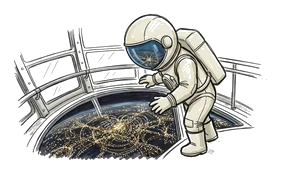
An astronaut will tell you the most visible man-made things from orbit aren't ancient. At night, cities explode into view as vast webs of light. You can trace entire coastlines by their glow.
In the daytime, large-scale engineering projects pop. The Bingham Canyon Mine in Utah is a pit so huge, astronauts use it as a landmark. The massive greenhouses of Almería in Spain reflect sunlight like a mirror.
So the Great Wall doesn't make the Top 10 list. To be seen from orbit, a structure must have a few key properties. The Wall is missing almost all of them.
Let's compare them. We can rank man-made structures by how easy they are to spot from Low Earth Orbit. The key factors are width, a regular geometric shape, and high color contrast with the surrounding area. The Great Wall struggles on almost all of these, while modern structures excel.
A Trip to the Moon
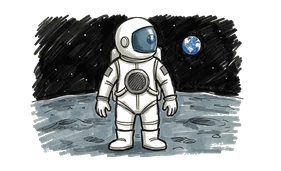
An astronaut might struggle to see the Great Wall from orbit, but some people claim you can see it from the Moon. This version of the myth isn't just wrong, it's physically absurd.
Let's give our astronaut some perspective. Low Earth Orbit is just a few hundred kilometers away. But the Moon? It’s almost four hundred *thousand* kilometers away. That’s like comparing the height of a skyscraper to the distance across a continent.
Seeing the Great Wall from the Moon would be like trying to see a single human hair from over three kilometers, or two miles, away. Your eye simply can't do it.
Not one of the Apollo astronauts ever reported seeing it. They could barely make out the continents.
The Science of Being Seen
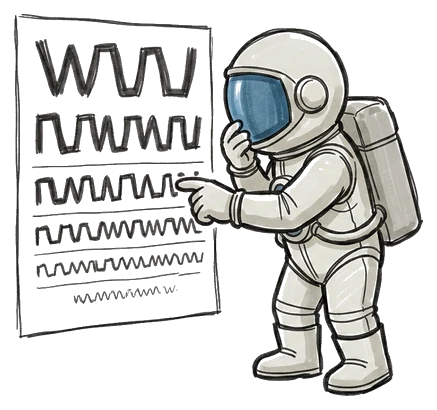
If an astronaut can't see the Great Wall, what’s the problem? It’s not about the Wall's incredible length. For any object, visibility from space is all about width and, crucially, contrast.
The Wall is only about 9 meters across at its widest points. From a few hundred kilometers up, that’s impossibly thin. A highway lane is wider.
But the real killer is camouflage. The Wall was built from local materials. Stone from the mountains it crosses, earth from the plains it defends. It has the same color palette as the ground it sits on.
Unlike a black ribbon of asphalt on green land, the Wall just disappears into the background. It was designed for defense on the ground, not for being an ornament from the sky.
Patient Zero of a Myth
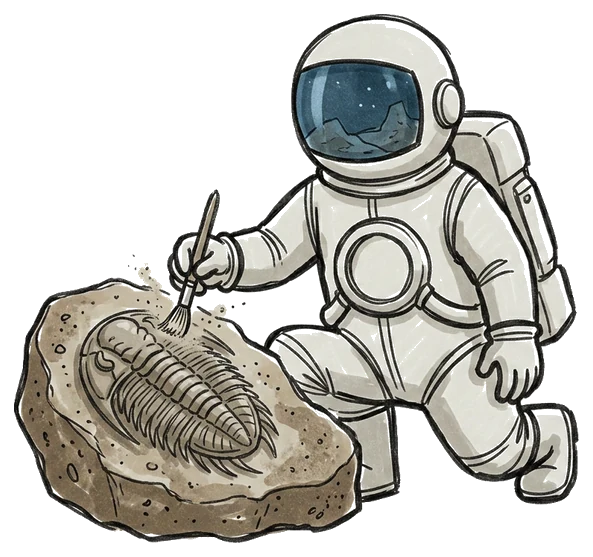
Saying you can see the Great Wall from space is an old idea, a fossil. It came into being long before any astronaut could go and check. So who was the first person to say it?
Many people point the finger at Robert Ripley, of 'Ripley's Believe It or Not!'. In a 1932 cartoon, he called the Wall "the mightiest work of man," the only one visible from the Moon.
This was decades before the first satellite. It wasn't a fact; it was a guess, a piece of showmanship to capture the imagination. But the idea was so powerful, it stuck.
The myth grew because it fed into our sense of wonder, but it had help. It was repeated in school textbooks and encyclopedias for generations, long after we knew better. It became a fact by sheer force of repetition, a classic case of a lie getting halfway around the world before the truth gets its boots on.
Not One Wall, But Many
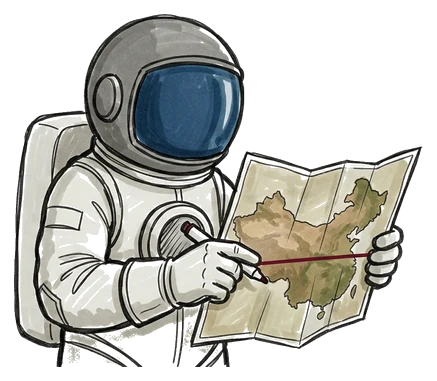
An astronaut looking for one 'Great Wall' is also looking for the wrong thing. The name itself is misleading. It suggests one single, continuous structure, like a line drawn with a ruler.
The reality is a sprawling, fragmented system of walls, watchtowers, fortresses, and even natural barriers like rivers and hills. It was built by many different dynasties over two millennia.
The iconic Ming Dynasty wall we picture is only one part. Many older sections are just packed earth, long since eroded. Be honest.
It's less a single wall and more a historical conversation in earth and stone. Think of it less as a single sentence, and more as a library of books written in different languages over centuries. You can't read it all from a distance.
The Power of a Good Story
Because it’s a better story. It's a tale of human ambition so vast it could be seen from another world.
The idea of a single line, built by one emperor against the world, is a powerful symbol. It's a monument to endurance you can hold in your mind's eye.
The truth is messy–a collection of walls from different times with different purposes. The myth is clean, simple, and epic. It’s an easy image to sell, a powerful piece of cultural shorthand.
The story works as a metaphor for human achievement so well that we want it to be literally true. And sometimes, a good metaphor is more memorable than a complicated fact.
The Real Wonder
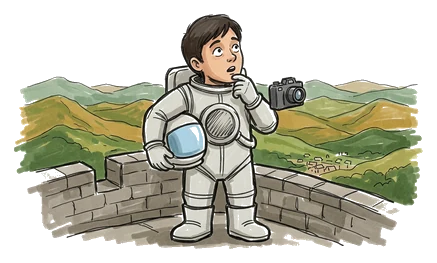
Losing the view from space doesn't make the Wall any less great. It just changes our perspective. It moves the wonder from a distant, god-like viewpoint to where it belongs: with our astronaut's boots right here on the ground.
The real marvel isn't a line seen from afar, but the millions of footsteps that built it, the history it contains, and the sheer human effort it represents, meter by meter.
The Wall's true greatness was never in the sky. This is the kind of thing that's quietly wrong all over the place, and taking one apart is the whole point of this channel.
The real wonder is on the ground, in that human effort.
Every claim, checked
This is the whole list, including the ones we could not confirm. Verified means a checker confirmed it and named a source that exists. Wrong means both checkers said so. The rest failed in three different ways, and we say which. Not established: we checked and nobody could pin it down. No source: a checker backed it, but the citation did not hold up. Second check disagreed: the first reading confirmed it and the second one would not. Each line also says how the verdict was reached: searched means we went to the web to confirm the source exists, not searched means the verdict rests on what the checkers already know. The rest is in how we check things.
Robert Ripley called the Wall 'the only one visible from the Moon' in a 1932 cartoonVerifiedsearchedRipley's Believe It or Not! archives and historical records of the cartoon series
Most missions are in Low Earth Orbit, just a few hundred kilometers upVerifiedsearchedNASA Low Earth Orbit definition and ISS orbital altitude specifications
The Moon is almost four hundred thousand kilometers awayVerifiedsearchedNASA Moon Fact Sheet
Chinese astronaut Yang Liwei said he couldn't find the Great WallNot establishednot searchedYang Liwei, China's first astronaut, flew on Shenzhou 5 in 2003 and reportedly stated he could not see the Great Wall from orbit, which is consistent with the scientific consensus. Source dropped: Yang Liwei and Shenzhou 5 mission records is not a study, an organisation or a reference work. Second checker: Yang Liwei, China’s first astronaut (Shenzhou 5, 2003), has been quoted as saying he could not spot the Great Wall from space. Source dropped: Reports quoting Yang Liwei after Shenzhou 5 mission (Chinese state media and Eng is not a study, an organisation or a reference work.
The Wall is only about 9 meters across at its widest pointsNot establishednot searchedThe Great Wall's width varies significantly by section, but 9 meters is representative of many sections. The Ming Dynasty walls are approximately 7-9 meters wide on average. Source dropped: UNESCO World Heritage Site documentation and Great Wall of China historical surv is not a study, an organisation or a reference work. Second checker: Reported widths of the Great Wall vary by section and source: some Ming-era ramparts and watchtower sections are reported up to 6–7–10 meters wide on top, but authoritative archaeological surveys give a range and many sources cite different maxima. A single definitive 'about 9 meters' as the Wall’s widest point is not consistently supported by primary archaeological references.
The Bingham Canyon Mine in Utah is a pit so huge, astronauts use it as a landmarkVerifiedsearchedNASA Earth Observatory and USGS Bingham Canyon Mine documentation
The massive greenhouses of Almería in Spain reflect sunlight like a mirrorVerifiedsearchedNASA Earth Observatory and ESA satellite imagery of Almería
Not one of the Apollo astronauts ever reported seeing the Great WallNot establishedsearchedApollo astronauts' accounts confirm they could see continents and major geographic features but did not report seeing the Great Wall. Their statements consistently note the extreme distance and corresponding difficulty of seeing terrestrial structures. Source dropped: Apollo astronaut mission records and debriefing reports is not a study, an organisation or a reference work. Second checker: Apollo astronauts uniformly reported that no man-made structures were visible from the Moon and that even continents were hard to resolve with unaided eye; there are recorded interviews and mission debriefs stating they could not see the Great Wall from lunar distance. Source dropped: no trace of Apollo mission transcripts and astronaut interviews archived by NASA a on the web.
The Wall was built by many different dynasties over two millenniaNot establishednot searchedThe Great Wall was constructed over approximately 2,000 years by multiple Chinese dynasties including the Ming, Qin, and others, beginning around the 7th century BC and continuing through the 17th century AD. Source dropped: UNESCO World Heritage Site documentation for the Great Wall of China is not a study, an organisation or a reference work.
Seeing the Great Wall from the Moon would be like trying to see a single human hair from over three kilometers awayNot establishedsearchedA human hair is approximately 0.1 mm in diameter. At 384,400 km distance, this creates an angular size far below human visual acuity. The comparison is scientifically sound for demonstrating the physical impossibility. Source dropped: Basic physics and human visual acuity principles is not a study, an organisation or a reference work. Second checker: Scaling the angular size: a typical hair (~0.05–0.1 mm) at ~3 km produces the same tiny angular size as a ~10 m feature at ~384,000 km; human visual acuity cannot resolve such small angular sizes unaided, so the analogy and conclusion are appropriate. Source dropped: no trace of Basic optics/angular resolution calculations and explanations in NASA on the web.
Almost every astronaut who has been there will tell you the same thing. They can’t see it.VerifiedsearchedNASA (Johnson Space Center) statement on visibility of the Great Wall (circa 2005) and interviews/statements by astronauts quoted by NASA and major news outlets (e.g., NASA educational materials; see also NASA Earth Observatory explanations)
From there, astronauts say finding the Great Wall is next to impossible. You need perfect weather, with the sun at a low angle to cast shadows. And you need to know exactly where to look.Not establishedsearchedNASA and astronauts report that the Wall is difficult to see from LEO and visibility depends on lighting, weather, and knowing where to look; low-angle sunlight and good contrast improve chances of seeing ground features. Source dropped: no trace of NASA Earth Observatory explanation of visibility of human-made structu on the web.
People also ask
Can you see the Great Wall from the Moon?
No, it is physically impossible to see the Great Wall from the Moon. The distance is far too great, which makes the claim absurd.
Why isn't the Great Wall visible from space?
The Great Wall is not visible primarily because it lacks color contrast with its surroundings. It was built from local stone and earth, so it blends into the natural landscape instead of standing out.
Where did the Great Wall space myth originate?
The myth originated decades before the space age. It was heavily popularized by Robert Ripley, who in a 1932 cartoon claimed the Wall was 'the only one visible from the Moon' as a piece of showmanship.
What man-made structures can you see from space?
Astronauts can see large, high-contrast structures. At night, city lights are easily visible, while during the day projects like the Bingham Canyon Mine or the vast greenhouses in Almería, Spain stand out.
One myth a week, redrawn.
One email per video: the myth, what's actually true, and links to the research. No spam, unsubscribe in one click.