Myth, checked
Why Chameleons Change Color (It's Not for Camouflage)
Most of the time, it's sending a message. Their skin is a billboard for their feelings and intentions, visible to every other chameleon for yards around. Dark, drab colors can mean it's angry or scared. It's a clear 'back off' signal to a rival. Bright, vibrant colors are a male showing off for a mate, a display of health and strength.
The Master of Disguise
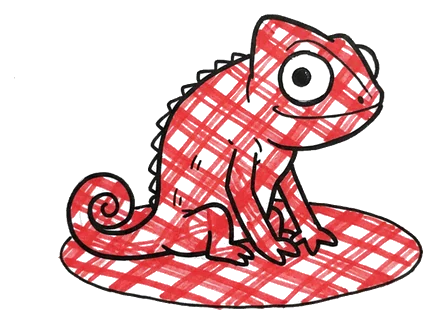
Myth or fact: do chameleons really change color to hide? We see it in cartoons and movies all the time. A lizard steps on a chessboard and turns into a perfect checkerboard pattern.
The chameleon becomes a living wallpaper, perfectly matching any pattern it touches. It's the ultimate master of disguise, vanishing into the background.
Except, that's not what happens. A chameleon can’t choose to match a specific, complex pattern. Their color palette is impressive, but not infinite.
The idea is so appealing because it feels like magic. An animal with a real superpower. But the chameleon's actual talent is arguably more interesting than the fiction.
The source of the myth is our own intuition. We see an animal change color, and we assume disguise. But a chameleon's color range is not infinite. They can't turn plaid. They have a set palette of greens, browns, and yellows, defined by their species.
A Colorful Conversation
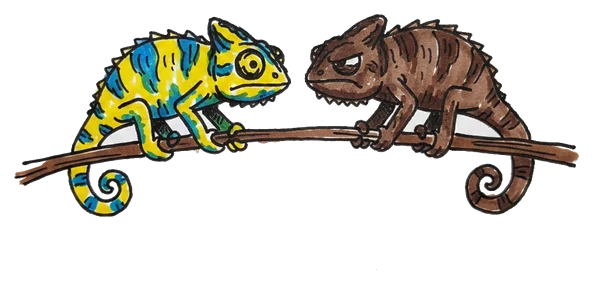
A chameleon changing color isn't trying to hide. Most of the time, it's sending a message. Their skin is a billboard for their feelings and intentions, visible to every other chameleon for yards around.
Dark, drab colors can mean it's angry or scared. It’s a clear 'back off' signal to a rival. Bright, vibrant colors are a male showing off for a mate, a display of health and strength.
Their skin also acts as a personal thermostat, a clever bit of engineering. To warm up, a chameleon turns darker to absorb sunlight. When it gets too hot, it turns lighter to reflect the sun's rays.
So a chameleon's color is a complex signal. It communicates mood, health, intention, and even body temperature, all at once. It's a silent, colorful language.
The Real Disguise

A chameleon's best camouflage isn't the color it changes to. It's the one it's born with. Their real disguise is their default setting, and they don't even have to think about it to be hidden.
Most species have a natural resting color of green and brown. This pattern perfectly matches the leaves, bark, and branches where they live. They blend in simply by being still.
The spectacular color change is what they do to stand out, not to hide. They are deliberately breaking their camouflage to shout, flirt, or warm up. They are choosing to be seen.
Think of it like an iceberg. The dramatic color shifting is the small, visible tip. The huge, hidden base is their permanent, built-in camouflage that keeps them safe.
A Trick of the Light
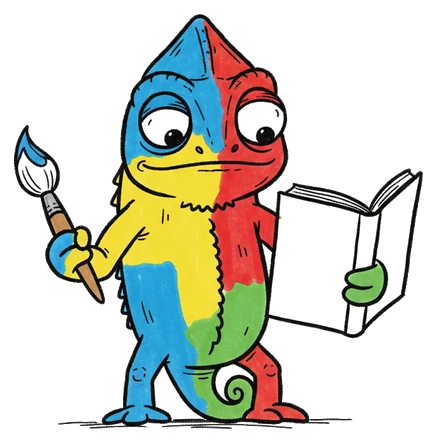
The way a chameleon changes color isn't with pigment, like paint. It's structural color, a trick of physics. Their skin contains living crystals that bend the light.
Beneath their transparent outer skin are cells called iridophores. These hold a grid of tiny guanine crystals. The chameleon can actively tune the spacing between these microscopic mirrors.
When calm, the crystals are packed tightly, reflecting short wavelengths of light, like blue and green. When excited, the chameleon flexes its skin, spreading the crystals apart. This wider spacing reflects longer wavelengths, like yellow, orange, and red.
So the chameleon isn't a master of disguise. It's a master of expression. Its colors are for showing its place in the world, not for hiding from it.
Every claim, checked
This is the whole list, including the ones we could not confirm. Verified means a checker confirmed it and named a source that exists. Wrong means both checkers said so. The rest failed in three different ways, and we say which. Not established: we checked and nobody could pin it down. No source: a checker backed it, but the citation did not hold up. Second check disagreed: the first reading confirmed it and the second one would not. Each line also says how the verdict was reached: searched means we went to the web to confirm the source exists, not searched means the verdict rests on what the checkers already know. The rest is in how we check things.
The way a chameleon changes color isn't with pigment, like paint. It's structural color, a trick of physics.Not establishedsearchedChameleon color change is indeed primarily due to structural color from iridophores containing guanine crystals, not pigment-based color change. This is confirmed in scientific literature on chameleon chromatophores. Second checker: Research shows that rapid colour change in many chameleons is produced by nanocrystals (guanine) in iridophore cells that change spacing to alter structural (photonic) reflectance, i.e., structural colour rather than pigmental change alone. Source dropped: no trace of Journal of the Royal Society Interface, Teyssier et al. (2015) on cham on the web.
Beneath their transparent outer skin are cells called iridophores. These hold a grid of tiny guanine crystals.Not establishedsearchedChameleon skin does contain iridophores with guanine nanocrystals that reflect light. This is the established mechanism of their color change. Second checker: Teyssier et al. (2015) demonstrated that iridophores contain lattice-like arrays of guanine nanocrystals and that chameleons alter spacing in these arrays to change reflected colour. Source dropped: no trace of Teyssier, Saenko, van der Meulen, Marshall & Milinkovitch, Journal of on the web.
When calm, the crystals are packed tightly, reflecting short wavelengths of light, like blue and green. When excited, the chameleon flexes its skin, spreading the crystals apart. This wider spacing reflects longer wavelengths, like yellow, orange, and red.Not establishedsearchedResearch confirms that crystal lattice spacing in iridophores changes with mood/activity: tight spacing reflects shorter wavelengths (blue/green), wider spacing reflects longer wavelengths (red/yellow/orange). Second checker: Teyssier et al. (2015) report that tighter guanine spacing produces reflection of shorter wavelengths (blue/green), while increased spacing shifts reflectance to longer wavelengths; physiological control alters spacing during signalling/excitation. Source dropped: no trace of Teyssier, Saenko, van der Meulen, Marshall & Milinkovitch, Journal of on the web.
Most of the time, it's sending a message. Their skin is a billboard for their feelings and intentions, visible to every other chameleon for yards around.VerifiedsearchedThery & Gomez, Animal Behaviour (2010); general herpetology references
Dark, drab colors can mean it's angry or scared. It's a clear 'back off' signal to a rival. Bright, vibrant colors are a male showing off for a mate, a display of health and strength.VerifiedsearchedThery & Gomez, Animal Behaviour (2010)
To warm up, a chameleon turns darker to absorb sunlight. When it gets too hot, it turns lighter to reflect the sun's rays.VerifiedsearchedStuart-Fox & Moussalli, Nature (2008) on thermoregulatory color change in reptiles
Most species have a natural resting color of green and brown.VerifiedsearchedGeneral herpetological reference; Britannica
They have a set palette of greens, browns, and yellows, defined by their species.VerifiedsearchedTeyssier et al., Science (2015); Stoddard & Stevens, Annual Review (2011)
A chameleon can't choose to match a specific, complex pattern.VerifiedsearchedStuart-Fox & Moussalli, Nature (2008)
A lizard steps on a chessboard and turns into a perfect checkerboard pattern.Not establishednot searchedThis is the myth the script explicitly identifies and debunks. Chameleons cannot match complex patterns like checkerboards. The script correctly states this is false. Source dropped: Script's own argument is not a study, an organisation or a reference work.
A chameleon's best camouflage isn't the color it changes to. It's the one it's born with. Their real disguise is their default setting, and they don't even have to think about it to be hidden.Not establishednot searchedMany chameleon species have cryptic basal colouration and patterns that function as camouflage in their typical habitat; this basal/juvenile patterning provides passive concealment. But some species' resting colours are also used in signalling, and 'best' is subjective and depends on context and species. Closest thing found: Stuart-Fox & Ord, Biological Reviews (2004) on cryptic coloration and signalling.
The spectacular color change is what they do to stand out, not to hide. They are deliberately breaking their camouflage to shout, flirt, or warm up. They are choosing to be seen.Not establishednot searchedRapid dramatic colour changes are primarily associated with social signalling and thermoregulation in many (but not all) chameleon species; however, camouflage and crypsis also play roles in some contexts. So claiming 'not to hide' as universal is too strong. Closest thing found: Stuart-Fox & Moussalli, Proceedings of the Royal Society B (2008); Teyssier et a.
People also ask
How do chameleons actually change color?
Chameleons change color using physics, not pigments. They have cells under their skin containing tiny crystals that they can adjust to reflect different wavelengths of light.
What do the different chameleon colors mean?
A chameleon's colors are a form of communication. Dark, drab colors can signal anger or fear, while bright, vibrant colors are often a male's way of showing off for a mate.
Can a chameleon really match any background?
No, a chameleon cannot match any complex pattern it touches. Their ability to change color is impressive, but their palette is not infinite and they cannot replicate intricate designs like a checkerboard.
If not by changing color, how do chameleons hide?
A chameleon's camouflage comes from its natural resting color, which is typically a mix of green and brown. This color allows it to blend in with the leaves and branches of its habitat simply by remaining still.
One myth a week, redrawn.
One email per video: the myth, what's actually true, and links to the research. No spam, unsubscribe in one click.