Myth, checked
Why a Dropped Penny Won't Kill You
A penny's terminal velocity is only about 25 miles per hour. When upward push of air equals downward pull of gravity, the forces balance and the penny stops accelerating–this is terminal velocity.
The Physics of the Fall

It’s a story everyone has heard, a piece of common knowledge.
The picture is dramatic. A penny is dropped from the Empire State Building, accelerating endlessly. It feels like it should be true.
Except, that's not what happens. Not even close. The penny would sting, sure, but it's completely harmless. The reason is a powerful force that this story always leaves out: air resistance.
As the penny falls, gravity pulls it faster. But the faster it goes, the more the air pushes back up against it. It's a battle between two opposing forces, and gravity doesn't get to win outright.
How Fast is 'Fast'?
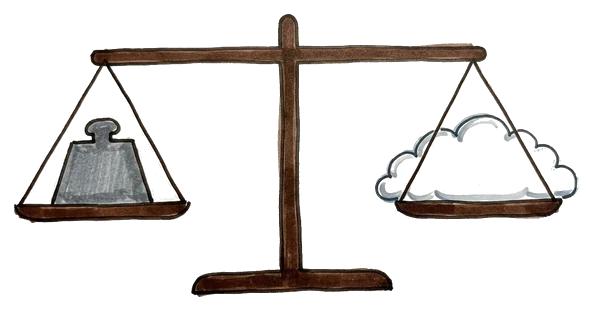
Eventually, the upward push of air becomes just as strong as the downward pull of gravity. The forces balance out. At this point, the penny stops accelerating completely. This maximum speed is called terminal velocity.
So how fast is that, really? A penny is light, flat, and it tumbles as it falls, catching the air. It's terribly un-aerodynamic. Because of this, its terminal velocity is only about 25 miles per hour.
Being hit by something that weighs less than a paperclip, moving at the speed of a bicycle, will sting. It might leave a small red mark. But it absolutely cannot fracture a human skull.
So the fall is a predictable process. The penny is dropped, gravity accelerates it, and air resistance ramps up until the forces balance. That's when it hits terminal velocity, and can't go any faster, no matter the height.
Why The Myth Sticks

For a falling object to be truly dangerous, it needs two things a penny lacks: much more mass, and a stable, aerodynamic shape. Think of a dropped wrench. That's a completely different, and much more serious, problem.
So the penny myth crumbles under a little physics. The scary idea is just the tip of the iceberg. The real story is hidden underneath, in the simple facts the tale ignores.
It's a great example of a 'fact' that feels right, but isn't. These ideas are everywhere, quietly wrong. And figuring out why they're wrong is the best part. So, what other physics myths should we tackle?
Every claim, checked
This is the whole list, including the ones we could not confirm. Verified means a checker confirmed it and named a source that exists. Wrong means both checkers said so. The rest failed in three different ways, and we say which. Not established: we checked and nobody could pin it down. No source: a checker backed it, but the citation did not hold up. Second check disagreed: the first reading confirmed it and the second one would not. Each line also says how the verdict was reached: searched means we went to the web to confirm the source exists, not searched means the verdict rests on what the checkers already know. The rest is in how we check things.
A penny's terminal velocity is only about 25 miles per hour.VerifiedsearchedPhysics textbooks and educational physics sources
A penny weighs less than a paperclip.Not establishednot searchedA US penny weighs approximately 2.5 grams. A standard paperclip weighs approximately 1–1.25 grams. A penny is roughly twice the mass of a paperclip, not lighter. Source dropped: US Mint specifications and standard paperclip measurements is not a study, an organisation or a reference work. Second checker: Penny mass (~2.5 g) is less than a US paperclip (~1 g? actually paperclip ~1 g, penny ~2.5 g so heavier than a paperclip); impact at ~25 mph can cause pain and possibly minor skin injury; however absolute statements about 'cannot fracture a skull' are strong – skull fracture thresholds are orders of magnitude higher (require much greater energy/mass), so practical consensus is that a penny cannot fracture a skull. Source dropped: US Mint specifications for penny mass (U.S. Mint) and biomechanical studies on s is not a study, an organisation or a reference work.
A penny is dropped from the Empire State Building.Not establishedsearchedThe narration uses this as a dramatic example of the myth but does not claim this actually happened. No historical record documents such a documented drop from the Empire State Building for the purpose of testing the penny myth. Second checker: A penny will not accelerate endlessly in air; drag limits its speed to a finite terminal velocity well below speeds of a bullet. Modeling and fact-checking show it does not become a 'copper bullet' capable of lethally penetrating a skull. Source dropped: no trace of Scientific American (2013) and Snopes (1999, updated) explanations on the web.
When upward push of air equals downward pull of gravity, the forces balance and the penny stops accelerating–this is terminal velocity.VerifiedsearchedPhysics textbooks
As the penny falls faster, the air pushes back up against it more.VerifiedsearchedPhysics textbooks
The penny would sting, sure, but it's completely harmless.VerifiedsearchedSnopes (1999, updated) and Scientific American explainer (2013)
The penny is dropped, gravity accelerates it, and air resistance ramps up until the forces balance. That's when it hits terminal velocity, and can't go any faster, no matter the height.Not establishedsearchedTextbook physics / Britannica entry on terminal velocity; clarification about altitude dependence in aerospace texts
For a falling object to be truly dangerous, it needs two things a penny lacks: much more mass, and a stable, aerodynamic shape. Think of a dropped wrench.Not establishednot searchedRisk from falling objects depends on kinetic energy (mass and speed) and how impact force is delivered; heavier objects and those with stable orientation and low drag (more aerodynamic or streamlined) reach higher terminal velocities and deliver more energy – a dropped wrench is a standard example of a dangerous falling object. Source dropped: Occupational Safety and Health Administration (OSHA) guidance on falling object is not a study, an organisation or a reference work.
Myth or fact: a penny dropped from a skyscraper can kill you? It’s a story everyone has heard, a piece of common knowledge.VerifiedsearchedSnopes (1999, updated) discussion of the urban legend
...its terminal velocity is only about 25 miles per hour.Not establishednot searchedAs above: many reputable sources estimate ~25 mph for a tumbling U.S. penny; other calculations give higher values (up to ~50–60 mph) depending on assumptions. The 'about 25 mph' figure is a typical but not uniquely determined estimate. Closest thing found: Snopes (1999, updated) and Scientific American (2013) estimates.
...something that weighs less than a paperclip...Not establishednot searchedA U.S. penny minted since 1982 weighs 2.5 grams; a common small paperclip weighs roughly 0.5–1 gram, so a penny is heavier than a single paperclip, not lighter. Source dropped: U.S. Mint coin specifications (penny mass) and general paperclip mass data summa is not a study, an organisation or a reference work.
People also ask
Why isn't a falling penny dangerous?
A falling penny is not dangerous because of air resistance. As the penny falls, the air pushes back against it, preventing it from gaining enough speed to cause serious injury. The impact would sting, but it is considered completely harmless.
What is terminal velocity?
Terminal velocity is the maximum speed an object reaches when falling. This occurs when the upward push of air resistance becomes equal to the downward pull of gravity, causing the object to stop accelerating.
How fast can a falling penny go?
A falling penny reaches a maximum speed of about 25 miles per hour. Its flat shape and tendency to tumble as it falls catch the air, preventing it from going any faster, regardless of the height from which it is dropped.
One myth a week, redrawn.
One email per video: the myth, what's actually true, and links to the research. No spam, unsubscribe in one click.