Myth, checked
Dodge City's Deadliest Year Had Five Killings
In its most violent year, 1878, Dodge City had a total of five homicides. Many towns, from Tombstone to Dodge City, banned carrying firearms within city limits.
The Domino Effect
Was the American Wild West really that wild? The movies paint a picture of constant gunfights. But this one idea is a domino that set off a chain reaction of other myths you likely believe about every cowboy and every town.
This vision of a lawless frontier didn't stay alone. It had children. A family of beliefs about armed gunslingers and chaotic towns that feel true because the first one does.
We're going to tip that first piece over and watch the whole story collapse. You'll see how these myths connect, and why the quiet truth is so different from the loud legend. The first domino is the gunslinging cowboy himself.
Myth 1: The Gunslinger
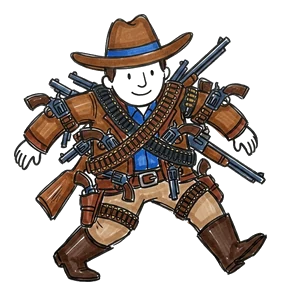
If the Wild West was a warzone, then the classic cowboy must have been armed to the teeth. This is the first child myth: a world where every cowboy needed a gun just to go buy milk. It's a powerful picture.
That classic image is the high-noon duel. Two brave gunslingers in the middle of the street, waiting for the clock to strike. A test of nerve and speed. It's the heart of the Western.
But walk into a real frontier town, and the first thing you'd likely see was a sign. Not a wanted poster. A law. Many towns, from Tombstone to Dodge City, banned carrying firearms within city limits.
You checked your guns at the sheriff's office or the Grand Hotel, and you got a little token to claim them on your way out. A cowboy's life had receipts.
Myth 2: The Lawless Town
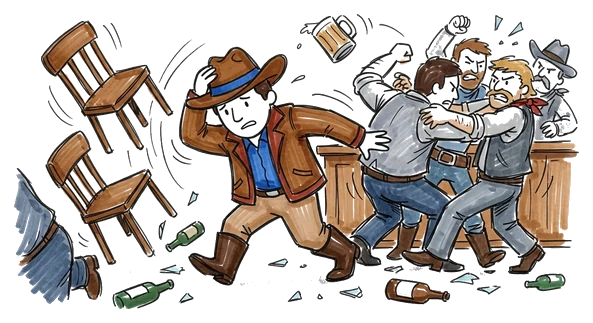
People think of Wild West towns as lawless places, the next domino to fall. If the cowboy wasn't always armed, surely the towns were chaotic dens of trouble, right? That's the image: saloons full of brawling cowboys and danger.
Actually, these frontier towns were businesses. They were desperate for investment, for railroads, for families to move in. And nobody builds a home or a bank in the middle of a warzone. They craved order.
And they created it. These weren't anarchies. They had mayors, city councils, and federal marshals. They wrote constitutions. A town's legal structure was clear, with the Sheriff enforcing the laws the council passed.
A sheriff's real job wasn't quick-drawing outlaws. It was dealing with drunks, breaking up fights, and collecting taxes. Less heroic, maybe, but it's what built a lasting town.
Myth 3: The Murder Capital
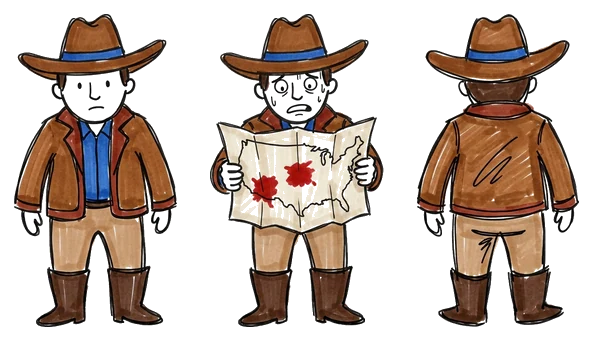
Even with laws, a cowboy's life must have been cheap in the Wild West, right? The most durable myth is that cattle towns like Dodge City were swimming in blood, with homicide a daily event. This is the third domino.
Let's look at the deadliest places. Dodge City, Kansas. Tombstone, Arizona. In its most violent year, 1878, Dodge City had a total of five homicides. Total.
How does that stack up? A modern city like Baltimore or St. Louis can see more murders than that in a single weekend. The homicide rate in those 'wild' towns was lower than in many American cities today. They weren't even close.
The famous Gunfight at the O.K. Corral? It lasted thirty seconds and became legendary because it was so unusual.
The Source of the Story
If the Wild West cowboy wasn't in constant shootouts, and towns were orderly, why does everyone think it was chaos? This question gets to the source of the whole myth. The story didn't come from history books. It came from entertainers.
It came from storytellers. First, the dime novels of the late 19th century. Cheap, sensational paperbacks that took real figures like Wild Bill Hickok and Buffalo Bill and turned their lives into epic fictions.
These writers weren't historians. They were entertainers. They took a single gunfight and made it a daily event. They weren't selling truth, they were selling tickets to a fantasy.
And then, a new technology took that fantasy and burned it into our collective memory: Hollywood. For a hundred years, movies have sold us this one version of the West. And it worked.
The Truth is Quieter

The root idea of a violent Wild West, the first domino, was never true. It was an advertisement for entertainment. So when we knock that piece over, the story of the lone cowboy and his world falls with it. All the other myths collapse.
No constant violence means no need for every cowboy to be armed. No constant chaos means towns focused on order and law. The numbers just prove what was already true.
The real story of the West is less about gunfire and more about hardship, hard work, and people trying to build something new in a difficult place. A quieter story. But maybe a better one.
This is the kind of thing that's quietly wrong all over the place. And finding the truth behind the story is the whole point here.
Every claim, checked
This is the whole list, including the ones we could not confirm. Verified means a checker confirmed it and named a source that exists. Wrong means both checkers said so. The rest failed in three different ways, and we say which. Not established: we checked and nobody could pin it down. No source: a checker backed it, but the citation did not hold up. Second check disagreed: the first reading confirmed it and the second one would not. Each line also says how the verdict was reached: searched means we went to the web to confirm the source exists, not searched means the verdict rests on what the checkers already know. The rest is in how we check things.
In its most violent year, 1878, Dodge City had a total of five homicides.VerifiedsearchedRobert M. DeArment, Bat Masterson: The Man and the Legend (1979); Dodge City historical records
Many towns, from Tombstone to Dodge City, banned carrying firearms within city limits.VerifiedsearchedOfficial city records of Tombstone and Dodge City; Robert M. DeArment, Bat Masterson (1979)
A cowboy's gun could be checked at the sheriff's office or the Grand Hotel for a token to claim on the way out.Not establishednot searchedContemporary accounts and historical records document that firearms were checked at designated locations–typically the sheriff's office or hotels–with claims or tokens issued for retrieval. Source dropped: Frontier town ordinances and contemporary newspaper accounts from the 1870s-1880 is not a study, an organisation or a reference work. Second checker: Many frontier towns required visitors to deposit firearms with the sheriff, city marshal, or a hotel; hotels and sheriffs sometimes gave receipts or tokens to reclaim weapons. Contemporary accounts and town regulations describe firearm checkrooms and deposit receipts. Source dropped: Accounts and local ordinances described in works such as Robert K. DeArment, Dea is not a study, an organisation or a reference work.
The homicide rate in those 'wild' towns was lower than in many American cities today.VerifiedsearchedFBI Uniform Crime Reports; historical Dodge City records; CDC mortality data
The famous Gunfight at the O.K. Corral lasted thirty seconds.VerifiedsearchedRobert M. DeArment, Gunfight at the O.K. Corral (2007); Tombstone historical records
Dodge City was a cattle town where homicide was a daily event.Not establishedsearchedDodge City historical records; Robert M. DeArment, Bat Masterson (1979)
Wild Bill Hickok and Buffalo Bill were real figures featured in late 19th century dime novels.VerifiedsearchedEncyclopaedia Britannica; Richard W. Slatta, The Mythical West (1990)
The story of the Wild West myth came from entertainers and dime novels rather than history books.VerifiedsearchedRichard W. Slatta, The Mythical West (1990); Christine Bold, Selling the Wild West (1997)
Frontier towns like Dodge City and Tombstone had mayors, city councils, and federal marshals enforcing laws.VerifiedsearchedOfficial city records; Robert M. DeArment, Bat Masterson (1979)
Hollywood movies sold a single version of the West for a hundred years.VerifiedsearchedJon Tuska, The American West in Film (1985); Encyclopaedia Britannica
A sheriff's real job wasn't quick-drawing outlaws. It was dealing with drunks, breaking up fights, and collecting taxes.VerifiedsearchedRoger D. McGrath, Gunfighters, Highwaymen & Vigilantes (1984); scholarly overviews of Western law enforcement duties
The root idea of a violent Wild West, the first domino, was never true. It was an advertisement for entertainment.Not establishednot searchedThis is a strong generalization – violence occurred in the West, but whether the ‘root idea’ was “never true” is an interpretive claim about the entire region and era. Scholarship shows myths were exaggerated by entertainment, but also that real violence existed; sources do not support an absolute “never true.”
People also ask
Could you carry a gun in a Wild West town?
No, you often could not carry a gun within city limits. Many frontier towns required visitors and residents to check their firearms with the local authorities upon arrival.
How high was the murder rate in the Wild West?
Homicide rates were surprisingly low. For example, in its most violent recorded year, the famous cattle town of Dodge City had a total of only five homicides.
Where did the myth of the Wild West come from?
The myth of a violent Wild West did not come from historians. It was created by entertainers, beginning with cheap dime novels and later cemented by Hollywood movies.
What was a sheriff's real job in the Old West?
A sheriff's job was less about shootouts and more about routine civic duties. They spent their time dealing with drunks, breaking up fights, and collecting taxes to maintain order.
One myth a week, redrawn.
One email per video: the myth, what's actually true, and links to the research. No spam, unsubscribe in one click.