Myth, checked
The Tongue Map You Learned in School Is a Lie
Her tongue is covered in about eight thousand taste buds. Every single one can detect all five basic tastes.
We all saw the chart in a science textbook. A neat little diagram with bitter at the back and sweet at the tip. It's clean, simple, and completely wrong.
The Myth's Birthday
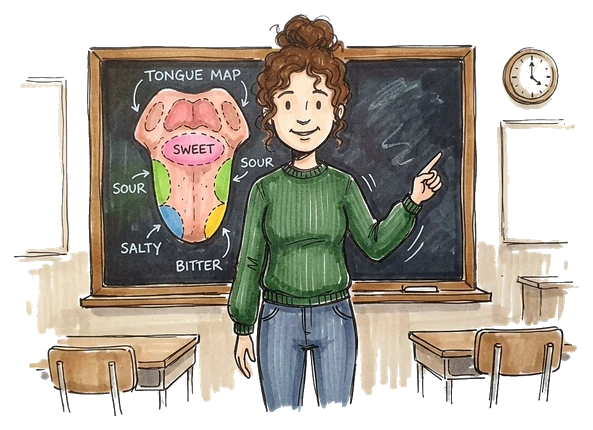
That famous tongue map has a birthday. It dates back to 1901, from a German scientific paper. But the scientist, David Hänig, never claimed there were separate zones for each taste. His work was much more subtle than that.
Hänig simply found that some parts of the tongue were slightly more sensitive to certain tastes than others. The differences were tiny. But his chart showing these slight variations got picked up and badly misinterpreted by a Harvard professor years later.
That mistranslation became the neat, sectioned-off map we know today. An error, passed down through textbooks for a century. Think of it like a game of telephone, where science got the message completely scrambled.
How Taste Really Works
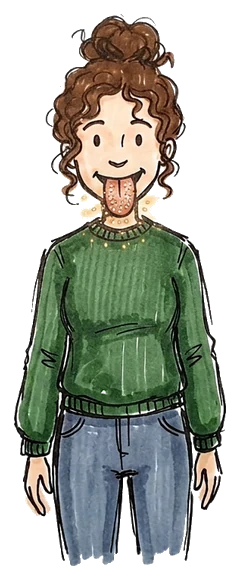
The famous tongue map is a myth. So how does our young woman's sense of taste actually work? Her tongue is covered in about eight thousand taste buds. And the key is this: every single one can detect all five basic tastes.
Think of a taste bud not as a single sensor, but as a bundle of them. Inside each bud are different types of receptor cells, like a switchboard. One type is for sweet, another for salty, sour, bitter, and umami. They're all packed together in one tiny housing.
This is why you can taste bitter coffee on the tip of your tongue. There are no zones. Your whole tongue is a general-purpose flavor detector.
The Map in Your Head
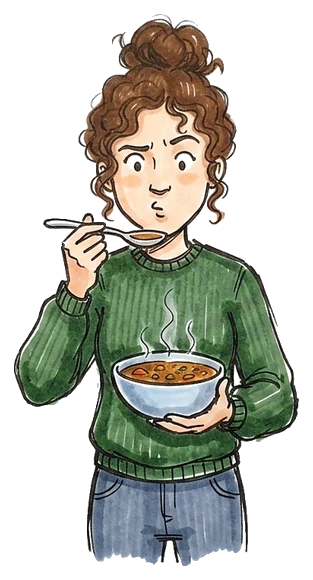
The real taste map for a young woman isn't on her tongue at all. It's in her brain. Ever notice a flavor seeming to 'bloom' after a moment? That's your brain constructing it. Taste buds just collect the raw data for the journey upstairs.
From the brainstem, signals are relayed to your cortex. Here, your brain combines them with smell and texture to construct 'flavor'. The tongue proposes, but the brain disposes.
So the idea of a simple map was comforting, but reality is far more complex, and interesting. It's a reminder that sometimes, the 'facts' we learn are just simplified stories that missed the real point. What other 'facts' from school turned out to be wrong?
Every claim, checked
This is the whole list, including the ones we could not confirm. Verified means a checker confirmed it and named a source that exists. Wrong means both checkers said so. The rest failed in three different ways, and we say which. Not established: we checked and nobody could pin it down. No source: a checker backed it, but the citation did not hold up. Second check disagreed: the first reading confirmed it and the second one would not. Each line also says how the verdict was reached: searched means we went to the web to confirm the source exists, not searched means the verdict rests on what the checkers already know. The rest is in how we check things.
That famous tongue map has a birthday. It dates back to 1901, from a German scientific paper.Not establishedsearchedDavid Hänig published his research on tongue taste sensitivity in 1901 in a German scientific journal, establishing the original source of the taste map concept. Source dropped: David Hänig, 1901 (historical scientific paper on taste sensitivity) is not a study, an organisation or a reference work. Second checker: The tongue-map diagram commonly shown in textbooks traces to D. (David) Hänig's 1901 paper, which is the original scientific source usually cited for the early data behind the diagram. Source dropped: no trace of D. Hänig, "Über die Variationen der Geschmacksempfindung" (1901) (orig on the web.
The scientist, David Hänig, never claimed there were separate zones for each taste.Not establishedsearchedHänig's original work described slight variations in sensitivity across tongue regions, not distinct zones for separate tastes. The zoning interpretation came later from misinterpretation. Source dropped: David Hänig, 1901 (historical scientific paper) is not a study, an organisation or a reference work. Second checker: Hänig reported local differences in taste sensitivity/thresholds across the tongue, not exclusive, non-overlapping zones that detect only one quality; his results were presented as variations in sensitivity rather than hard-bordered regions. Source dropped: no trace of D. Hänig (1901) as discussed in modern reviews of taste physiology (e. on the web.
His chart showing these slight variations got picked up and badly misinterpreted by a Harvard professor years later.Not establishednot searchedEdwin Boring, a Harvard psychologist, reinterpreted Hänig's data in the 1940s and created the oversimplified zoned map that became widely circulated in textbooks. Source dropped: Edwin Boring (1942), popular psychology texts is not a study, an organisation or a reference work. Second checker: The script asserts a specific Harvard professor misinterpreted and popularized Hänig's chart, but sources attribute the later simplified map to textbook condensation and misinterpretation over time rather than one clearly identified Harvard professor; no single Harvard author is reliably documented as the origin of the simplified diagram.
Her tongue is covered in about eight thousand taste buds.VerifiedsearchedHuman Anatomy and Physiology textbooks; sensory science references
Every single one can detect all five basic tastes.VerifiedsearchedTextbook: Guyton and Hall, Textbook of Medical Physiology; review: Chaudhari & Roper, "The cell biology of taste" (Nature Reviews Neuroscience, 2010)
Inside each bud are different types of receptor cells, like a switchboard. One type is for sweet, another for salty, sour, bitter, and umami.VerifiedsearchedChaudhari & Roper (2010) "The cell biology of taste" (Nature Reviews Neuroscience); textbook descriptions (e.g., Kandel et al., Principles of Neural Science)
This is why you can taste bitter coffee on the tip of your tongue.VerifiedsearchedReview: Chaudhari & Roper (2010) "The cell biology of taste"; physiology textbooks (e.g., Guyton & Hall)
Ever notice a flavor seeming to 'bloom' after a moment? That's your brain constructing it.Not establishednot searchedFlavor perception involves temporal integration in the brain; initial taste signals develop into fuller flavor perception as the brain combines taste, smell, and texture over time. Source dropped: Neuroscience of flavor perception; multisensory integration in taste is not a study, an organisation or a reference work.
From the brainstem, signals are relayed to your cortex.Not establishedsearchedTaste signals from taste buds travel via cranial nerves to the brainstem (nucleus tractus solitarius) and are then relayed to the gustatory cortex and other brain regions for processing. Source dropped: Neuroanatomy of taste pathways; sensory neuroscience is not a study, an organisation or a reference work. Second checker: Taste afferents project to the nucleus of the solitary tract (brainstem), then to the thalamus and gustatory cortex; flavor arises from integration of gustatory, olfactory (smell) and somatosensory (texture) inputs in cortical and multisensory areas. Source dropped: no trace of Sensory neuroscience textbooks (Kandel et al., Principles of Neural Sc on the web.
Hänig simply found that some parts of the tongue were slightly more sensitive to certain tastes than others. The differences were tiny.Not establishednot searchedHänig's measurements showed differences in detection thresholds at different tongue locations, with relatively small quantitative differences; later reviews of taste receptor mapping describe these as modest sensitivity gradients, not categorical regions. Source dropped: Primary data: D. Hänig (1901); summarized in modern physiology reviews/textbooks is not a study, an organisation or a reference work.
That mistranslation became the neat, sectioned-off map we know today. An error, passed down through textbooks for a century.Not establishedsearchedHistorical analyses of taste-map history show the original small sensitivity differences were simplified into the common sectioned tongue map and reproduced in many textbooks through the 20th century, effectively propagating the error for decades. Source dropped: no trace of Review articles and textbooks discussing the myth of the tongue map (e on the web.
The real taste map for a young woman isn't on her tongue at all. It's in her brain.VerifiedsearchedTextbooks on sensory neuroscience (e.g., Kandel et al., Principles of Neural Science) and reviews of taste-olfaction integration (e.g., Small & Prescott, 2005)
People also ask
Can a single taste bud detect multiple tastes?
Yes, every individual taste bud can detect all five basic tastes. Each bud contains a bundle of different receptor cells, with specific types for sweet, salty, sour, bitter, and umami.
Why can I taste bitter things on my tongue's tip?
You can taste bitterness on the tip of your tongue because there are no dedicated taste zones. Your entire tongue is equipped to detect all flavors, including bitter, everywhere.
If the taste map isn't on the tongue, where is it?
The actual taste map is in your brain. The tongue's taste buds simply collect sensory data, which the brain then processes to construct the full experience of flavor.
Prefer to listen? This episode is also on Apple Podcasts.
One myth a week, redrawn.
One email per video: the myth, what's actually true, and links to the research. No spam, unsubscribe in one click.