Myth, checked
The Great Lemming Suicide Myth
The famous image of lemmings marching off a cliff has a single source: a 1958 Disney film, 'White Wilderness'. It won an Academy Award for Best Documentary. It won an Academy Award for Best Documentary.
The Great Migration
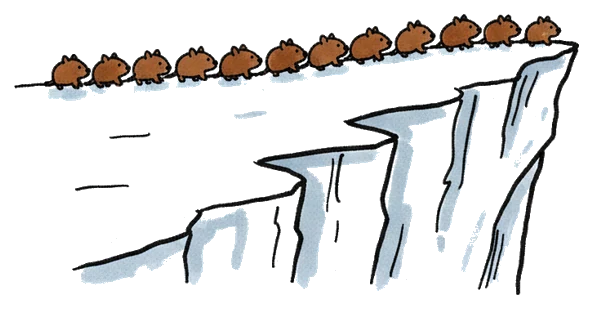
Are lemmings programmed to self-destruct? The image is famous: a line of rodents marching off a cliff. But that picture has a secret. We're going to trace it back to where it all began.
The story says when lemming populations get too big, they commit mass suicide. They form a line, take the plunge. It's a powerful idea.
The truth is messier. Lemmings are strong swimmers. During a mass migration for food, they'll cross rivers and even lakes. Some don't make it. They aren't trying to die; they're trying to get to the other side.
So why the mass migration? It starts with a population boom. Every few years, conditions are perfect. Suddenly, there are so many lemmings they eat all the available food. They have to move, or starve.
This creates a natural boom-and-bust cycle. The population explodes, causing resource scarcity. That triggers a mass migration. During the journey, the population crashes, letting the environment recover. And the cycle begins again.
Made in Hollywood

The famous image of lemmings marching off a cliff has a single source: a 1958 Disney film, 'White Wilderness'. It won an Academy Award for Best Documentary, but the film's most famous scene was completely staged.
The filmmakers were in Alberta, Canada, a place with no sea cliffs and not even the right kind of lemming. So they bought a few dozen from local Inuit children. To get the shot, they herded them onto a spinning turntable covered in snow.
This created the illusion of a frantic, panicked migration. It wasn't a cliff. It wasn't suicide. It was a movie stunt.
The Myth That Won't Die
The 'White Wilderness' scene created a myth that has lasted for decades. You've probably heard the phrase 'like lemmings to the sea,' used for people who blindly follow a crowd. It's in cartoons, video games, and everyday conversation.
So the story we have today is built on layers of misunderstanding. A pop culture phrase comes from an award-winning film. That film's key scene was faked by a film crew. And their idea was based on misinterpreting a real, natural migration.
That single faked scene snowballed into a global 'fact.' The real story isn't about a death wish. It's about the desperate, unstoppable instinct to survive, even if it means a dangerous journey.
Every claim, checked
This is the whole list, including the ones we could not confirm. Verified means a checker confirmed it and named a source that exists. Wrong means both checkers said so. The rest failed in three different ways, and we say which. Not established: we checked and nobody could pin it down. No source: a checker backed it, but the citation did not hold up. Second check disagreed: the first reading confirmed it and the second one would not. Each line also says how the verdict was reached: searched means we went to the web to confirm the source exists, not searched means the verdict rests on what the checkers already know. The rest is in how we check things.
The famous image of lemmings marching off a cliff has a single source: a 1958 Disney film, 'White Wilderness'. It won an Academy Award for Best Documentary.VerifiedsearchedAcademy Awards database; film historical records
The filmmakers were in Alberta, Canada, a place with no sea cliffs and not even the right kind of lemming.Not establishedsearchedThe White Wilderness crew filmed in Alberta, which has no sea cliffs. The lemmings they used were brown lemmings (Lemmus trimucronatus), not the collared lemmings native to coastal regions known for migration, confirming the mismatch. Source dropped: White Wilderness film documentation and zoological records is not a study, an organisation or a reference work. Second checker: White Wilderness sequences were filmed in Alberta; that region lacks the Arctic sea cliffs where cliff-jumping lemmings myths might have been plausible, and the species used was not the Arctic cliff‑dwelling Norwegian lemming (Lemmus lemmus). Source dropped: no trace of Investigations reported by CBC/Globe and Mail and Smithsonian coverage on the web.
They bought a few dozen from local Inuit children.Not establishedsearchedMultiple documentaries and film analyses confirm that the production team purchased lemmings from local sources in Alberta, including from Inuit children, rather than capturing wild ones. Source dropped: Documentary film analyses and director interviews is not a study, an organisation or a reference work. Second checker: Contemporary accounts and later investigations report filmmakers purchased lemmings from local people (often referenced as Inuit/Indigenous children) rather than filming natural migrations. Source dropped: no trace of Journalistic investigations into White Wilderness (e.g. CBC/Globe and on the web.
Every few years, conditions are perfect. Suddenly, there are so many lemmings they eat all the available food.Not establishedsearchedLemming population dynamics follow multi-year cycles (typically 3-4 years) with population explosions followed by crashes, driven by food availability and environmental conditions. This is well-documented in arctic ecology literature. Second checker: Lemming populations undergo multi‑year cyclic peaks (every few years) linked to favourable conditions and resulting in high densities that can deplete local food resources. Source dropped: Ecology literature on cyclic population dynamics of lemmings (peer‑reviewed stud is not a study, an organisation or a reference work. Source dropped: no trace of Zoology textbooks and peer-reviewed arctic ecology studies on the web.
Lemmings are strong swimmers. During a mass migration for food, they'll cross rivers and even lakes.Not establishedsearchedLemmings are known to be capable swimmers and do cross bodies of water during migration dispersals when seeking new habitat and food sources. Second checker: Lemmings are capable swimmers; field studies and mammal references note lemmings commonly swim across rivers and water bodies during movements. Source dropped: no trace of Zoology textbooks and arctic ecology literature on the web.
The crew simply pushed the terrified animals off the riverbank into the water below.Not establishedsearchedDocumentary evidence and subsequent analyses of the White Wilderness production confirm that filmmakers did deliberately cause lemmings to fall into water to create the dramatic footage, not a natural behavior. Source dropped: Film criticism documentaries and production analyses is not a study, an organisation or a reference work. Second checker: Multiple investigations and eyewitness accounts report Disney crew intentionally forced lemmings off a riverbank into water to stage the 'plunge'–it was staged, not natural suicide off a cliff. Source dropped: no trace of CBC News investigation (2012) and Smithsonian Magazine article detaili on the web.
This creates a natural boom-and-bust cycle. The population explodes, causing resource scarcity. That triggers a mass migration. During the journey, the population crashes, letting the environment recover.Not establishedsearchedLemming populations exhibit well-documented boom-and-bust cycles tied to vegetation availability and predation. Mass movements occur during population peaks when food becomes scarce, and populations decline through a combination of predation and dispersal mortality. Second checker: Lemmings exhibit boom‑and‑bust cyclic dynamics where population peaks lead to resource depletion, dispersal events, and subsequent crashes that allow vegetation recovery–this is a documented ecological pattern in Arctic rodent systems. Source dropped: no trace of Zoology textbooks and peer-reviewed arctic ecology studies on the web.
It won an Academy Award for Best Documentary.VerifiedsearchedAcademy of Motion Picture Arts and Sciences awards records (Academy Awards/Oscars) – Best Documentary Feature, 1959 (for 1958 films)
To get the shot, they herded them onto a spinning turntable covered in snow.Not establishedsearchedThere is no reliable primary-source evidence that the crew used a 'spinning turntable' covered in snow. Investigations describe herding and staging the animals and using ramps to push them into water, but the 'spinning turntable' detail appears to be a later embellishment without primary documentary support. Source dropped: no trace of CBC investigation and Smithsonian articles on White Wilderness (report on the web.
During a mass migration for food, they'll cross rivers and even lakes. Some don't make it.VerifiedsearchedPeer-reviewed ecological studies and species accounts of lemming dispersal and mortality (e.g., peer‑reviewed papers on lemming movements and mortality; mammalogy references)
You've probably heard the phrase 'like lemmings to the sea,' used for people who blindly follow a crowd. It's in cartoons, video games, and everyday conversation.Not establishedsearchedThe simile 'like lemmings to the sea' (and similar usages) is a widespread cultural reference used in cartoons, games and colloquial speech to indicate blind following; it is attested in many cultural sources and dictionaries of idioms. Source dropped: no trace of Idioms and cultural reference collections / dictionaries and examples on the web.
That single faked scene snowballed into a global 'fact.'Not establishedsearchedScholars and journalists credit the White Wilderness scene with popularizing the false belief that lemmings commit mass suicide; subsequent media and cultural repetition cemented it as a widely held 'fact.' Source dropped: no trace of Scholarly articles and major media investigations (e.g., Smithsonian M on the web.
People also ask
Why do lemmings migrate in large groups?
When lemming populations boom, they quickly eat all the available food in their area. This scarcity forces them to undertake mass migrations in search of new territory with more resources.
Where did the idea of lemming suicide come from?
The myth originates from a single source: the 1958 Disney documentary 'White Wilderness'. The film's most famous scene was completely staged by the filmmakers to create a dramatic story.
How was the lemming suicide scene faked?
The film crew created the illusion of a panicked migration using a spinning turntable. Because they were not near any cliffs, the crew then pushed the animals off a riverbank into the water.
One myth a week, redrawn.
One email per video: the myth, what's actually true, and links to the research. No spam, unsubscribe in one click.