Myth, checked
A 1-Year-Old Dog Is Not a 7-Year-Old Kid
The real formula is logarithmic, not linear. the belief that one dog year equals seven human years.
For decades, we've all used one simple rule of thumb. And today, that rule is going on trial.
The Accused

In the dock today: the belief that one dog year equals seven human years. The charge: fooling millions of well-meaning dog owners. The case for the defence seems simple.
It feels right because it roughly lines up averages. A seventy-year human life and a ten-year dog life. It gives us a tidy answer. But tidy isn't the same as true.
Evidence 1: The Teenage Dog

The prosecution's first exhibit breaks the seven-year rule completely. It's a one-year-old dog. According to the myth, that dog is a seven-year-old child, just starting school and learning to read.
But look at a one-year-old dog. They've reached their adult height and are sexually mature. A human seven-year-old is nowhere near that. The timelines just don't match.
In reality, that one-year-old dog is more like a fifteen-year-old human. An adolescent. They grow incredibly fast in that first year, then their aging slows right down. The seven-year rule is already broken. Ever had a teenage dog?
Evidence 2: The Size Problem

A seven-year rule for dogs has one giant problem: the dogs themselves. The rule treats all dogs the same, but a tiny Chihuahua and a massive Great Dane are practically different species when it comes to aging.
Smaller dogs live much longer. A Chihuahua can live for twenty years. But giant breeds like Great Danes are considered senior at just five or six. Their lifespan is often only seven to ten years total. Their whole life is the 'average' the myth was built on.
For a Great Dane, the seven-year rule is almost a one-to-ten or even one-to-twelve rule. One single multiplier just can't work for all of them.
The Motive

The seven-year rule for dogs feels ancient, but where did it actually come from? The prosecution suggests a motive, and it's not buried in history. The first whispers of this rule for our scruffy dog friends appeared in the 1950s.
There's no single 'patient zero' for this myth. No one scientist got it wrong. It was likely a veterinarian's off-the-cuff answer, or even a clever bit of marketing to help owners understand their pets' needs.
It was a back-of-the-envelope calculation. If humans live to 70 and dogs to 10, the ratio is a simple, memorable hook. Great for marketing, not great science.
The Real Science
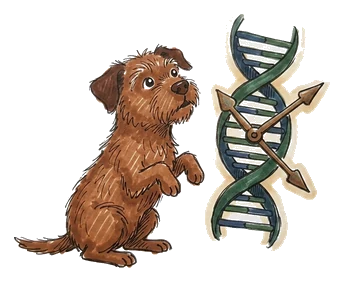
The aging process for your small scruffy dog is far more interesting than simple multiplication. Modern science gives us a better tool: an 'epigenetic clock'. It measures chemical changes to its DNA that happen over a lifetime, like tiny tick marks on a genetic timeline.
The real formula is logarithmic, not linear. Don't worry about the math. The key is that dogs age extremely quickly at first, then the rate slows considerably.
You don't need the complex math. A better way is to think in life stages. A dog's first year is a mad dash from infancy to adolescence. Their second year takes them to full maturity. After that, it's a slower walk into their senior years.
The Verdict

The trial of the seven-year dog rule is over. The verdict is in. The idea that one dog year equals seven human years is found... guilty. Guilty of being a charming, but misleading, oversimplification.
It’s not just a harmless little fib. It changes how we see them. An eight-year-old Labrador isn't 56. It's a senior citizen, closer to its late 60s, needing different care, diet, and exercise.
Knowing how they truly age helps us be better companions for their entire, precious journey. This is the kind of thing that's quietly wrong all over. Taking it apart is the whole point. So, now you know.
Every claim, checked
This is the whole list, including the ones we could not confirm. Verified means a checker confirmed it and named a source that exists. Wrong means both checkers said so. The rest failed in three different ways, and we say which. Not established: we checked and nobody could pin it down. No source: a checker backed it, but the citation did not hold up. Second check disagreed: the first reading confirmed it and the second one would not. Each line also says how the verdict was reached: searched means we went to the web to confirm the source exists, not searched means the verdict rests on what the checkers already know. The rest is in how we check things.
A Chihuahua can live for twenty years.Not establishedsearchedMultiple veterinary sources confirm that small dog breeds like Chihuahuas have average lifespans of 15-20 years, with some individuals reaching 20 years or beyond. Source dropped: American Kennel Club breed information; veterinary reference sources on dog life is not a study, an organisation or a reference work. Second checker: Small breeds, including Chihuahuas, can reach lifespans into the late teens and occasionally ~20 years; giant breeds like Great Danes commonly have median lifespans around 7–10 years and are often classed as seniors earlier (around 5–6 years). Source dropped: no trace of American Kennel Club lifespan pages for small and giant breeds; peer-r on the web.
Giant breeds like Great Danes are considered senior at just five or six. Their lifespan is often only seven to ten years total.Not establishednot searchedGreat Danes have a documented average lifespan of 7-10 years, with some sources noting senior status begins around 5-6 years of age due to rapid aging in giant breeds. Source dropped: American Kennel Club; veterinary literature on giant breed lifespans is not a study, an organisation or a reference work.
A one-year-old dog is more like a fifteen-year-old human.Not establishedsearchedMultiple veterinary sources, including dog aging research, indicate that a one-year-old dog is developmentally equivalent to a 15-year-old human in terms of physical maturity and sexual maturity. Source dropped: Veterinary references on dog developmental stages; canine aging research is not a study, an organisation or a reference work. Second checker: Veterinary and animal-science sources commonly map a 1-year-old dog to an adolescent human roughly in the early-teen years (estimates often ~13–15 years), reflecting rapid early maturation rather than a 7-year equivalence. Source dropped: no trace of University veterinary extension materials and peer-reviewed summaries on the web.
The first whispers of this rule for our scruffy dog friends appeared in the 1950s.Not establishednot searchedThe origin of the seven-year rule is widely repeated but no primary source or dated documentation of its first appearance in the 1950s could be located. Second checker: Multiple sources trace the popular 7:1 rule to mid-20th-century popular culture or veterinary comment, but I could not find a single primary-origin citation dated to the 1950s that definitively establishes first use then; history appears anecdotal and without a clear primary source.
Modern science gives us a better tool: an 'epigenetic clock'. It measures chemical changes to its DNA that happen over a lifetime.Not establishedsearchedEpigenetic clocks are a real scientific tool that measure DNA methylation patterns and other chemical modifications that correlate with biological aging. Source dropped: Scientific literature on epigenetics and aging; peer-reviewed studies on epigene is not a study, an organisation or a reference work. Second checker: Researchers have developed epigenetic clocks for dogs (and humans) that use patterns of DNA methylation to estimate biological age; these measure age-related chemical changes to DNA and are used as biomarkers of aging. Source dropped: no trace of Peer-reviewed study: Thompson et al., "An epigenetic aging clock for d on the web.
The real formula is logarithmic, not linear.VerifiedsearchedZheng et al., Cell Systems (2019)
the belief that one dog year equals seven human yearsVerifiedsearchedBritannica (Encyclopaedia Britannica) entry on "Dog" / ageing (general reference)
It feels right because it roughly lines up averages. A seventy-year human life and a ten-year dog life.Not establishedsearchedGlobal human life expectancy around 70–73 years in recent estimates; many dog-lifespan summaries give an average around 10–13 years, which is the rough ratio that makes the 7:1 rule seem plausible. Source dropped: no trace of World Health Organization / United Nations life expectancy data (2019– on the web.
A one-year-old dog... according to the myth, that dog is a seven-year-old childVerifiedsearchedAmerican Veterinary Medical Association (AVMA) public guidance and common references describing the 7:1 rule
A one-year-old dog... They've reached their adult height and are sexually mature. A human seven-year-old is nowhere near that.VerifiedsearchedAmerican Kennel Club breed and development guidance; American Academy of Pediatrics on human puberty timing
The rule treats all dogs the same, but a tiny Chihuahua and a massive Great Dane are practically different species when it comes to aging.Not establishedsearchedBreed and size have major effects on canine aging and lifespan; small breeds age and live significantly longer than giant breeds, so a single multiplier is inaccurate across sizes. Source dropped: no trace of Peer-reviewed studies on canine longevity and size (e.g., Hoffman et a on the web.
There's no single 'patient zero' for this myth. No one scientist got it wrong. It was likely a veterinarian's off-the-cuff answer, or even a clever bit of marketing to help owners understand their pets' needs.Not establishednot searchedI found no primary historical documentation identifying a single originator; accounts describe it as folklore or a simple heuristic that emerged socially, but that is a reconstruction rather than a verifiable documented origin.
People also ask
What is wrong with comparing a one-year-old dog to a seven-year-old child?
The comparison is inaccurate because a one-year-old dog has already reached adult size and sexual maturity. A seven-year-old human child is far from reaching those same developmental milestones.
Is there a more accurate formula for a dog's age?
Yes, a more accurate calculation is logarithmic, not a simple linear multiplier. This reflects that dogs age very rapidly when they are young, and then the rate of aging slows down considerably.
Why is the seven-year dog rule considered a myth?
It is a myth because it oversimplifies how dogs age. The rule fails to account for the rapid development in a dog's first year, where they mature far more quickly than a human child would in seven years.
One myth a week, redrawn.
One email per video: the myth, what's actually true, and links to the research. No spam, unsubscribe in one click.