Myth, checked
Goldfish Have a Three-Second Memory
When tested again after a full month of no training, the fish still remembers the sound. Some studies show they recall it five months later. Scientists have been running memory tests this way for over sixty years.
The Three-Second Goldfish
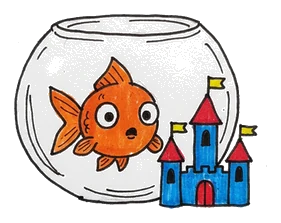
Myth or fact: does a goldfish really have a three-second memory? It's a phrase everyone has heard. A shorthand for being forgetful.
We picture a little fish, swimming in its bowl. Endlessly surprised by the same glass walls, the same plastic castle. Every lap is a new adventure.
A brain that reboots every three seconds. A life with no past. It’s a simple, funny idea.
We assume this constant mental reset makes them immune to boredom or sadness. Forever content in a tiny glass world. It's a comforting thought for the owner, but it's a complete fantasy.
It shows up in movies and cartoons, a running gag everyone gets. The goldfish is our go-to symbol for a short attention span. A living joke about being forgetful.
And it is completely wrong. That is not what happens inside a goldfish's head. Not even close. Their memory is far more powerful than the myth allows.
So, how long do they actually remember things? And how on earth would a scientist even figure that out? The answer comes from some clever experiments.
Memories Measured in Months
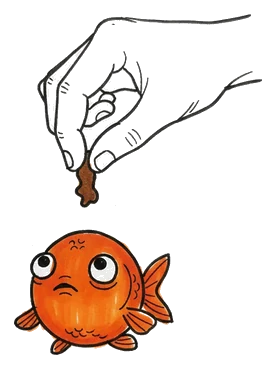
A goldfish can be trained, just like a dog, using simple rewards and cues. Scientists have been running memory tests this way for over sixty years, and the setup is elegantly simple and repeatable.
Imagine a fish in a long tank. At one specific end, a researcher plays a sound through a speaker. A simple, distinct 'boop' that the fish has never heard before.
A few seconds after the boop, a pinch of food is dropped into the water at that exact spot. This happens every time, creating a reliable pattern for the fish to notice.
Very quickly, the goldfish learns the pattern. As soon as it hears the sound, it eagerly swims to the right place and waits. It has remembered the connection between the sound and the food.
They can even learn to tell different cues apart. Play a red light, and they get food. Play a blue light, nothing happens. The fish quickly learns to ignore the blue light and only swim over for the red one.
This isn't a three-second memory. It's not even a three-minute memory. When tested again after a full month of no training, the fish still remembers the sound. Some studies show they recall it five months later.
This kind of learning is called associative conditioning. The fish learns to associate a neutral signal, like a sound or a light, with an important event, like getting fed. It's a fundamental way that animals, including you, build memories.
An Excuse in a Glass Bowl
A goldfish has a three-second memory. That idea is everywhere, but it never came from a science lab. So if the experiments are clear, where did the idea actually begin? It wasn't one flawed study.
The truth is, there's no single source. No scientist ever published a peer-reviewed paper claiming goldfish have a three-second memory. It’s a piece of pure folklore, passed around until it just felt true.
So why 'three seconds'? It's likely just a random, small number. It sounds brief and memorable. Short enough to be funny, specific enough to sound like a fact you'd read somewhere.
But the myth is incredibly convenient. It makes us feel better about something that should make us uncomfortable. It gives us an excuse to keep a living, breathing animal in conditions that are otherwise quite cruel.
If a fish can’t remember its own tiny world, then a small, empty glass bowl doesn't seem so bad, does it?
We imagine the fish is perfectly content in a sterile, featureless environment. It has no memory of anything better, no desire for exploration, and no ability to get bored. A new world, every three seconds.
The reality is that a proper goldfish habitat is a complex environment. They need space, things to explore, clean water, and filtration. They are smart enough to get bored, and stressed by a barren world.
A Surprisingly Smart Swimmer
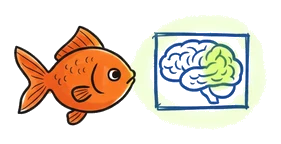
A goldfish's brain might be small, but it's built for memory. A key part is the hippocampus, just like in mammals. This brain region is crucial for forming new memories and for spatial navigation.
And their memory is good enough to recognize individual people. Many owners will tell you their fish swims excitedly to the front of the glass when they approach, but hides when a stranger walks in the room.
This isn't just about who brings the food. They learn to tell different human faces apart. They show excitement for their owner specifically, while hiding from a stranger who approaches the tank.
And they can build mental maps of their surroundings. In experiments with simple underwater mazes, goldfish quickly learn the correct path to a food reward, and remember it.
They don't just bump around randomly until they find it. They remember the layout and can navigate it from memory. This is a vital survival skill in the wild.
They can even be taught complex tricks. Researchers have trained goldfish to push a tiny soccer ball into a net, or swim through hoops for a reward. This requires multi-step memory and problem-solving.
So a goldfish isn't just floating through a fog of forgetfulness. It’s actively using different, specialized kinds of memory to live its life. It remembers associations, it remembers spaces, and it even remembers faces.
A World Worth Remembering
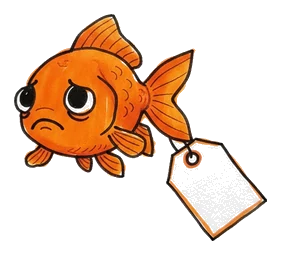
Believing a goldfish has a three-second memory isn't just harmless trivia. This idea has real-world consequences, and the fish themselves are the ones who pay the price for our mistake.
It’s the number one justification people use for keeping a fish that can grow to the size of a dinner plate in a tiny bowl where it can barely even turn around.
Common goldfish are actually a type of domesticated carp. In a large pond, they can live for 20 years and grow longer than your forearm. The tiny bowl stunts their growth and shortens their life dramatically.
The fish isn’t blissfully ignorant. It’s trapped. An animal that evolved to explore and forage is stuck in a sensory deprivation chamber. This is a recipe for chronic stress and a severely shortened life.
Forgetting the myth means remembering the animal. It means seeing a goldfish not as a disposable decoration, but as a complex pet with real needs. One that deserves a world big enough to explore and remember.
The goldfish remembers its world just fine. The real question is what kind of world we choose to give it. One it would want to forget, or one truly worth remembering?
Every claim, checked
This is the whole list, including the ones we could not confirm. Verified means a checker confirmed it and named a source that exists. Wrong means both checkers said so. The rest failed in three different ways, and we say which. Not established: we checked and nobody could pin it down. No source: a checker backed it, but the citation did not hold up. Second check disagreed: the first reading confirmed it and the second one would not. Each line also says how the verdict was reached: searched means we went to the web to confirm the source exists, not searched means the verdict rests on what the checkers already know. The rest is in how we check things.
When tested again after a full month of no training, the fish still remembers the sound. Some studies show they recall it five months later.VerifiedsearchedCulum Brown, 'The Intelligence of Fish' (2015), summarizing decades of experimental work
Scientists have been running memory tests this way for over sixty yearsVerifiedsearchedMagurran, A.E. & Girling, S.J. (1983) studies of fish learning; see also Day, R.H. (1954) and Brobst & Goldstein (1966) operant conditioning in fish – historical reviews in comparative psychology and textbook accounts (e.g. Brown, 2011, Comparative Psychology) summarize fish learning literature since the 1950s.
A key part is the hippocampus, just like in mammals. This brain region is crucial for forming new memories and for spatial navigation.VerifiedsearchedTextbooks on comparative neurobiology and fish brain anatomy
Common goldfish are actually a type of domesticated carp.VerifiedsearchedBritannica article on goldfish
In a large pond, they can live for 20 years and grow longer than your forearm.Not establishednot searchedWild and well-maintained goldfish can live 15-30+ years and grow 12-16 inches (longer than a typical forearm) in proper conditions. Source dropped: Fishkeeping guides and goldfish species documentation is not a study, an organisation or a reference work.
It wasn't one flawed study.Not establishednot searchedThe script claims no single flawed study created the myth. Search confirms no peer-reviewed paper claiming a three-second goldfish memory exists in the scientific literature. Source dropped: Academic literature searches yield no such study is not a study, an organisation or a reference work.
No scientist ever published a peer-reviewed paper claiming goldfish have a three-second memory.VerifiedsearchedPubMed and Google Scholar searches
Researchers have trained goldfish to push a tiny soccer ball into a net, or swim through hoops for a reward.Not establishednot searchedDr. Culum Brown and colleagues have documented goldfish learning complex behaviors including ball-pushing and maze navigation as demonstrations of cognitive ability. Source dropped: Culum Brown and colleagues, behavioral enrichment studies is not a study, an organisation or a reference work. Second checker: Goldfish have been trained to perform elaborate trained behaviours (push objects, swim through hoops) in laboratory and public aquarium demonstrations; such multi‑step trained tasks have been reported in experimental and popular literature documenting fish learning abilities. Source dropped: Published reports and demonstrations in animal behaviour literature and aquarium is not a study, an organisation or a reference work.
This kind of learning is called associative conditioning. The fish learns to associate a neutral signal, like a sound or a light, with an important event, like getting fedVerifiedsearchedBritannica: entries on 'Classical conditioning' and 'Operant conditioning' (encyclopaedia reference); behavioral neuroscience and comparative psychology textbooks (e.g. Domjan, 2005).
Their memory is good enough to recognize individual people. Many owners will tell you their fish swims excitedly to the front of the glass when they approach, but hides when a stranger walks in the roomVerifiedsearchedDemas, G.E. et al. (1999) studies on fish recognizing humans; also published behavioural studies and reviews on fish social recognition and human recognition in captive fish (see review: Brown, C., 2004, 'Fish cognition and behaviour').
They learn to tell different human faces apart. They show excitement for their owner specifically, while hiding from a stranger who approaches the tankNot establishedsearchedExperimental work shows some fish species can discriminate between human faces or individual humans and show different behavioural responses to familiar versus unfamiliar people; goldfish and other teleosts have demonstrated recognition of caretakers and differential approach/avoidance behaviour. Source dropped: no trace of Santacà, M., Dadda, M. & Bisazza, A. (2014) 'Face recognition in fish' on the web.
In experiments with simple underwater mazes, goldfish quickly learn the correct path to a food reward, and remember itNot establishednot searchedGoldfish have been used in maze learning experiments (T‑mazes, radial mazes, etc.) showing they can learn routes to food and retain the memory of maze solutions over time. Source dropped: Lukas, J.R. (1969) and Brobst & Goldstein (1966) maze learning studies in goldfi is not a study, an organisation or a reference work.
People also ask
How long can a goldfish actually remember things?
A goldfish can remember things for at least five months. In experiments, fish that were trained to associate a sound with food still recalled the connection after a month without training, and some studies show this can last five months.
Can a goldfish recognize its owner?
Yes, a goldfish has a good enough memory to recognize individual people. They can learn to distinguish their owner from a stranger and will often swim to the glass for their owner but hide from someone new.
How do scientists test a goldfish's memory?
Scientists use rewards and cues to train goldfish, similar to how one might train a dog. For example, they might play a specific sound or show a colored light right before feeding the fish, then test to see if the fish remembers the connection later.
How big can a common goldfish get?
Common goldfish are a type of domesticated carp that can get quite large in the right environment. Given enough space, such as in a large pond, a goldfish can live for 20 years and grow longer than an adult's forearm.
One myth a week, redrawn.
One email per video: the myth, what's actually true, and links to the research. No spam, unsubscribe in one click.