Myth, checked
Do Ostriches Bury Their Heads in the Sand?
The myth is ancient, starting with the Roman writer Pliny the Elder. But he never mentioned sand. He wrote that ostriches hide their head in a bush. They can maintain a speed of 70 kilometers per hour.
The Myth in the Sand
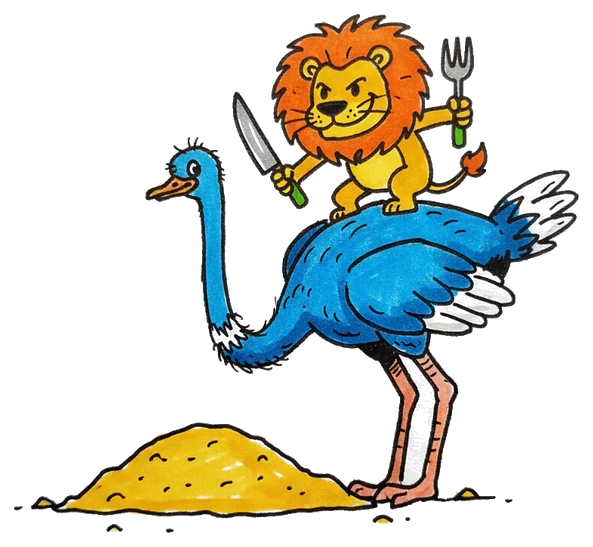
What's the first thing an ostrich does when it gets scared? You've seen the cartoons, you know the phrase. It buries its head in the sand. But what if that whole idea is just a story?
This image is everywhere. The giant bird, terrified, hiding its face and hoping the trouble goes away. It’s become a perfect symbol for anyone refusing to face a problem. It’s also completely wrong.
For one simple reason: an ostrich that buried its head in the sand would suffocate. It needs to breathe just like you do. This isn't a real defense. It's a death sentence.
The myth is ancient, starting with the Roman writer Pliny the Elder. But he never mentioned sand. He wrote that ostriches hide their head in a bush, thinking if they can't see you, you can't see them.
The Truth on the Ground
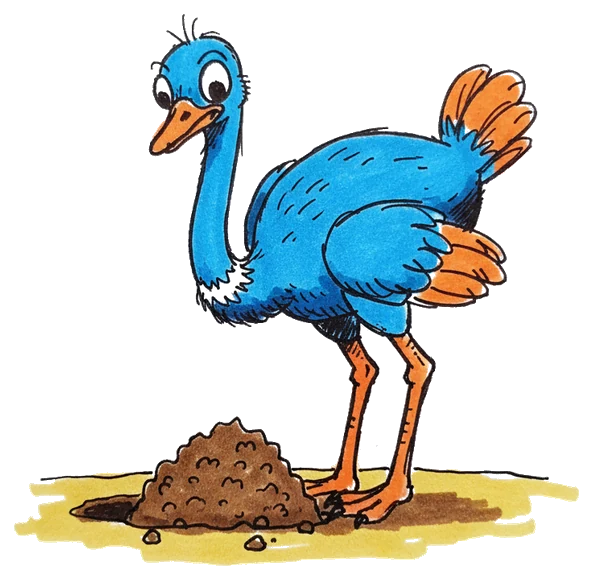
The sight of an ostrich with its head down comes from a simple misunderstanding. The real answer is about family. Ostriches don't live in trees. They dig shallow pits in the dirt to serve as nests for their enormous eggs.
Several times a day, a parent ostrich has to turn the eggs for them to incubate evenly. It does this by sticking its head and neck into the pit and using its beak. A long neck, a deep hole.
There's one other behavior that feeds the myth. When a predator is near, an ostrich might drop to the ground and lie perfectly still, pressing its long neck flat against the earth.
From a distance, the bird's body hides its head, whether it's tending a nest or lying flat. All an observer sees is an ostrich, standing one moment, and gone the next. The illusion is perfect, but that's all it is.
A Formidable Fighter
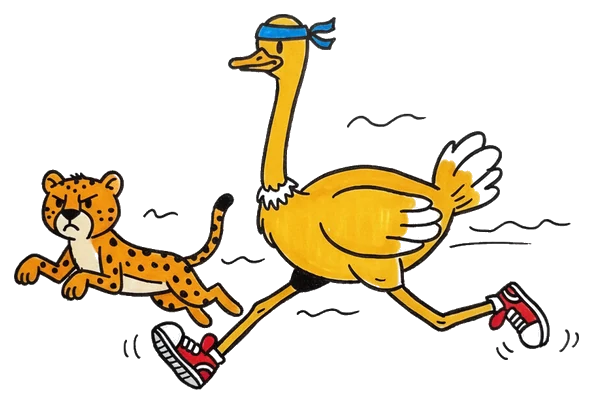
An ostrich's true defense isn't hiding; it's fighting or fleeing. When an ostrich decides to run, almost nothing on two legs can catch it. They can maintain a speed of 70 kilometers per hour.
And if it's cornered? Its legs are not just for running. They are incredibly powerful weapons. One forward kick carries enough force to seriously injure, or even kill, a lion.
So an ostrich has a full toolkit for survival. It can blend in by lying flat, it can outrun nearly anything, and as a last resort, it can fight back with a devastating kick. Burying its head is not on the list.
The myth of the cowardly ostrich is memorable because it makes a powerful creature seem foolish. The truth is much more impressive. This is an animal fully equipped to face its world. What other animal myths should we tackle?
Every claim, checked
This is the whole list, including the ones we could not confirm. Verified means a checker confirmed it and named a source that exists. Wrong means both checkers said so. The rest failed in three different ways, and we say which. Not established: we checked and nobody could pin it down. No source: a checker backed it, but the citation did not hold up. Second check disagreed: the first reading confirmed it and the second one would not. Each line also says how the verdict was reached: searched means we went to the web to confirm the source exists, not searched means the verdict rests on what the checkers already know. The rest is in how we check things.
The myth is ancient, starting with the Roman writer Pliny the Elder. But he never mentioned sand. He wrote that ostriches hide their head in a bush.VerifiedsearchedPliny the Elder, Natural History, Book 10
They can maintain a speed of 70 kilometers per hour.VerifiedsearchedEncyclopaedia Britannica (ostrich entry), and National Geographic (ostrich facts)
An ostrich that buried its head in the sand would suffocate. It needs to breathe just like you do.Not establishednot searchedOstriches, like all birds, require continuous breathing and would be unable to survive with their head submerged. This is basic avian physiology. Source dropped: Avian respiratory system, standard ornithology reference is not a study, an organisation or a reference work. Second checker: While birds need to breathe and burying an entire head deep in sand would obstruct breathing, I could not find a primary physiology source or field observation explicitly stating that an ostrich burying its head in sand would suffocate (the claim is frequently asserted in encyclopedias and popular sources as part of debunking the myth, but explicit experimental or observational documentation that burial causes suffocation is not located).
Ostriches dig shallow pits in the dirt to serve as nests for their enormous eggs.Not establishedsearchedOstriches do dig shallow holes in sand or earth to create nest pits for incubating eggs, a well-documented breeding behavior. Source dropped: San Diego Zoo Wildlife Alliance, ostrich breeding behavior is not a study, an organisation or a reference work. Second checker: Ostriches make shallow communal nest scrapes in the ground and lay very large eggs (among the largest of any bird); eggs are often described as enormous and nests are shallow depressions. Source dropped: no trace of Encyclopaedia Britannica (ostrich entry) and National Geographic (ostr on the web.
Several times a day, a parent ostrich has to turn the eggs for them to incubate evenly.Not establishedsearchedOstrich parents regularly turn eggs during incubation to ensure even heat distribution, a standard behavior in avian egg incubation. Source dropped: San Diego Zoo Wildlife Alliance, ostrich breeding behavior is not a study, an organisation or a reference work. Second checker: Ostrich parents turn eggs periodically to ensure even incubation; behavior observations report adults using their beaks to reposition eggs within the nest scrape. Source dropped: no trace of Avian breeding behavior summaries (e.g., Handbook of the Birds of the on the web.
One forward kick carries enough force to seriously injure, or even kill, a lion.Not establishednot searchedWhile ostrich kicks are documented as powerful and capable of causing serious injury or death to large predators, specific claims about killing lions lack quantified biomechanical data or documented encounters in scientific literature. Second checker: Ostrich kicks are powerful and have been documented to kill or seriously injure predators including lions; sources describe ostrich kicks as capable of killing or fatally wounding large predators. Source dropped: BBC Wildlife / reports summarized by BBC (ostrich defense) and National Geograph is not a study, an organisation or a reference work.
But he never mentioned sand. He wrote that ostriches hide their head in a bush, thinking if they can't see you, you can't see them.VerifiedsearchedPliny the Elder, Natural History (translation cited in secondary references such as Encyclopaedia Britannica)
Ostriches don't live in trees.VerifiedsearchedEncyclopaedia Britannica (ostrich entry)
When a predator is near, an ostrich might drop to the ground and lie perfectly still, pressing its long neck flat against the earth.Not establishedsearchedOstriches sometimes lie flat with neck outstretched to avoid detection, a camouflage behavior that can appear as if the head is hidden. Source dropped: no trace of Encyclopaedia Britannica (ostrich entry) and National Geographic (ostr on the web.
From a distance, the bird's body hides its head, whether it's tending a nest or lying flat. All an observer sees is an ostrich, standing one moment, and gone the next.VerifiedsearchedEncyclopaedia Britannica (ostrich entry)
It’s become a perfect symbol for anyone refusing to face a problem. It’s also completely wrong.Not establishednot searchedThe idiom of an 'ostrich burying its head in the sand' is widely used to mean willful avoidance; the statement 'it's completely wrong' – meaning ostriches do not bury heads in sand – is supported by natural-history sources that say the behavior does not occur in the literal sense. I mark this as 'partly supported' because the cultural idiom is well documented and the literal behavior is discredited by sources. Closest thing found: Oxford English Dictionary (idiom usage) and Encyclopaedia Britannica (behavior d.
People also ask
Why does it look like an ostrich is burying its head?
An ostrich puts its head in the ground to tend to eggs in its nest. The parent digs a shallow pit for a nest and must regularly turn the large eggs, which from a distance looks like its head is buried.
What do ostriches do when they feel threatened?
An ostrich's first instinct is not to hide, but to run away at high speeds. If cornered, an ostrich will lie down to blend in or turn and fight with a powerful kick.
How fast can an ostrich run?
An ostrich can run up to 70 kilometers per hour, making it one of the fastest animals on two legs. It is built for a quick escape and can cover five meters in a single stride.
Are ostriches dangerous to other animals?
Yes, an ostrich can be very dangerous if it feels cornered. Its legs are powerful and tipped with a large claw, delivering a forward kick that is capable of killing a lion.
One myth a week, redrawn.
One email per video: the myth, what's actually true, and links to the research. No spam, unsubscribe in one click.