Myth, checked
Did Humans Evolve From Monkeys?
This creature lived in Africa's forests around six to eight million years ago. It was created in 1965 for a popular Time-Life nature book.
The Picture In Your Head
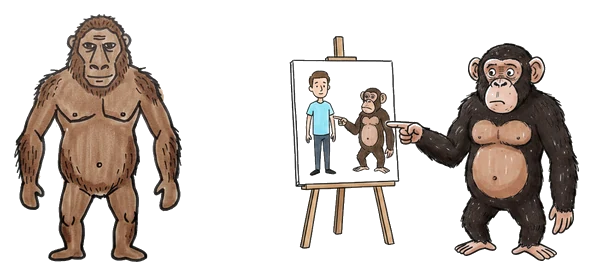
Are we just evolved monkeys? You've seen the picture everywhere: a line of creatures, starting with an ape, that slowly stands up straight and becomes a modern human.
It’s called the ‘March of Progress,’ and it’s one of the most famous, and most misleading, images in science. It feels right. It tells a simple story of a journey from them to us.
That straight line is a lie. We did not evolve from the chimps you see today. They are our cousins, not our ancestors. We both evolved from something else entirely.
Evolution isn't a ladder you climb to the top. It's a vast, sprawling bush that branches in every direction. We're just one twig.
The Common Ancestor
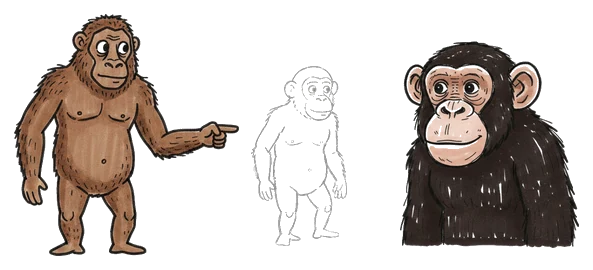
If humans and chimps didn't evolve from one another, where did we both come from? The answer is a shared grandparent. Scientists call this a common ancestor, a species that gave rise to both of us.
This creature lived in Africa's forests around six to eight million years ago. Critically, it wasn't a chimp and it wasn't a person. It was its own animal, which is now extinct.
Finding its fossils is the holy grail for paleoanthropologists. Every piece of jaw or tooth helps paint a picture of this crucial point in our family history.
From this starting point, its population split. One lineage evolved toward modern chimps. The other began a long journey through many stages, eventually becoming Homo sapiens. Two paths from one source.
Meet the Family
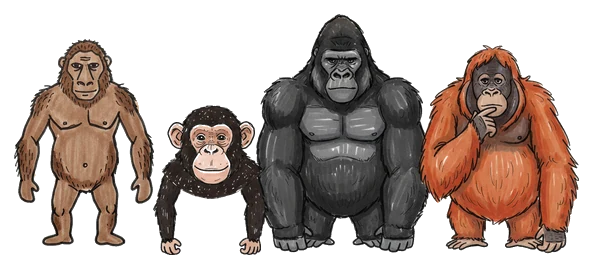
Humans are primates, but more specifically, members of the great ape family. It's an exclusive club. The only other living members are chimpanzees, bonobos, gorillas, and orangutans.
Our family tree shows who is most closely related to humans. Orangutans branched off first, then gorillas. The final split on our branch was between our lineage and the one leading to chimps, making them our closest living relatives.
And crucially, none of them are 'less evolved' than we are. They are perfectly adapted to their own environments. Their evolutionary journey is just as long as ours. They just took a different road to a different destination.
To call a chimp a 'primitive human' is as wrong as calling you a 'primitive chimp'. We are all modern species.
What Is a Monkey, Anyway?
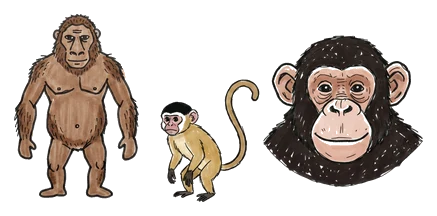
The word 'monkey' gets thrown around, but if chimps and gorillas are apes, what makes something a monkey? The distinction is a vital one in biology. For primates, it mostly comes down to two simple things: tails and location.
First, you have the New World monkeys, found only in the Americas. Most have fully prehensile tails, meaning they can use them like a fifth limb to grip branches. Think of spider monkeys.
Then there are the Old World monkeys of Africa and Asia. Their tails, if they have them, can't grip like that. Apes, like humans and chimps, are a branch of this Old World group, but we lost our tails completely.
So the simplest tell: apes don't have tails. Monkeys generally do. It's the clearest giveaway.
The Power of a Picture
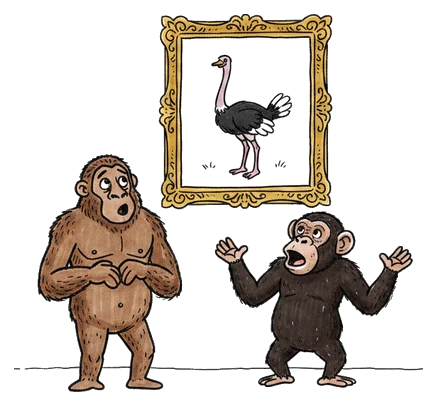
Why do so many people believe humans evolved from monkeys? For our early hominid and his chimp cousin, the answer lies in one powerful picture. It's called 'The March of Progress,' and it's why the myth survives.
It was created in 1965 for a popular Time-Life nature book. It wasn't the main point, just one illustration among many. But its visual simplicity was incredibly compelling and easy to remember.
The drawing implies a ladder of progress, with modern man at the peak. This flatters our ego and makes us feel like the goal of evolution.
Real evolution is a dense, sprawling bush, not a clean ladder. Branches shoot off in all directions. Most lead to dead ends. We're just one surviving twig on one branch of this enormous bush.
The DNA Doesn't Lie
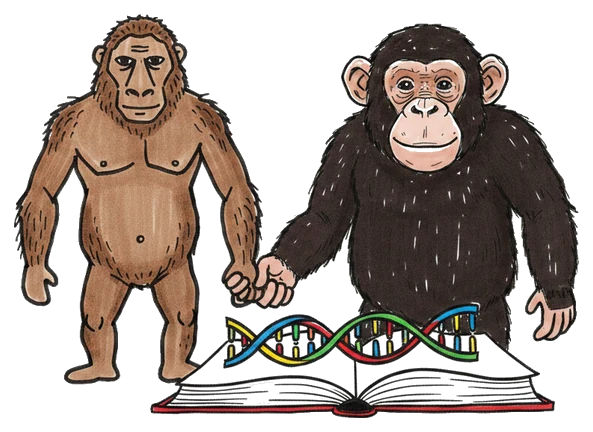
The family connection between humans and other apes isn't just in old bones. For this early hominid and his chimp cousin, the strongest proof is written in their DNA. It's a living history book telling an undeniable story of shared ancestry.
When scientists compare our genetic code to other great apes, the similarity is striking.
But that tiny percentage of difference between human and chimp DNA is also profound. It accounts for our giant brains, our capacity for complex language, and walking on two legs. It's amazing what a few million genetic typos can do.
This genetic closeness is the ultimate proof. Fossils can be misinterpreted, but the DNA code is a direct message from our shared ancestor. A hard fact worth saving.
A Better Story
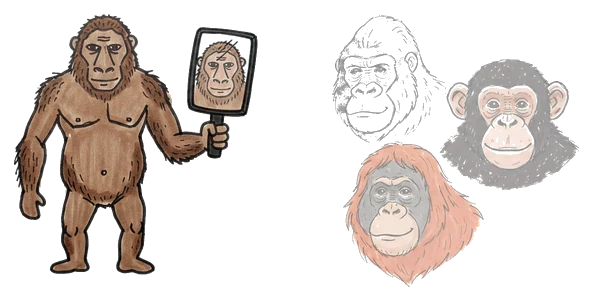
Where do our early hominid and his chimp cousin really fit in? The answer is clear: they are both great apes. But humans are not 'evolved monkeys'. Grasping this true relationship changes how we see ourselves in the grand story of life on Earth.
We are not the pinnacle of creation, the final step on a ladder. We are simply a part of it. A lucky survivor on a single branch that could have easily withered away millions of years ago.
The ladder story is simple, but empty. The tree story is chaotic, beautiful, and connects us to everything. We're all cousins, distant or close.
Every claim, checked
This is the whole list, including the ones we could not confirm. Verified means a checker confirmed it and named a source that exists. Wrong means both checkers said so. The rest failed in three different ways, and we say which. Not established: we checked and nobody could pin it down. No source: a checker backed it, but the citation did not hold up. Second check disagreed: the first reading confirmed it and the second one would not. Each line also says how the verdict was reached: searched means we went to the web to confirm the source exists, not searched means the verdict rests on what the checkers already know. The rest is in how we check things.
This creature lived in Africa's forests around six to eight million years ago.VerifiedsearchedGoodman et al., Molecular Biology and Evolution (2003); Arnason et al., Genetica (1996)
It was created in 1965 for a popular Time-Life nature book.VerifiedsearchedBritannica; documented art historical record
We share about 99% of our DNA with chimps, our closest living relatives, but also around 98% with gorillas, and 97% with orangutans.VerifiedsearchedKing and Wilson, Science (1975); Chimpanzee Sequencing and Analysis Consortium, Nature (2005)
The only other living members are chimpanzees, bonobos, gorillas, and orangutans.VerifiedsearchedInternational Union for Conservation of Nature (IUCN); textbook reference
Orangutans branched off first, then gorillas. The final split on our branch was between our lineage and the one leading to chimps.VerifiedsearchedGoodman et al., Molecular Biology and Evolution (2003); Pilbeam, Handbook of Paleoanthropology (2007)
Most have fully prehensile tails, meaning they can use them like a fifth limb to grip branches. Think of spider monkeys.VerifiedsearchedPrimatology textbooks; Campbell et al., Primates in Perspective (2006)
Their tails, if they have them, can't grip like that. Apes, like humans and chimps, are a branch of this Old World group, but we lost our tails completely.VerifiedsearchedTextbook reference; Fleagle, Primate Adaptation and Evolution (2013)
We did not evolve from the chimps you see today. They are our cousins, not our ancestors.VerifiedsearchedEncyclopaedia Britannica, entry “Human evolution” (consulted sources on relationships among living apes)
It's called the 'March of Progress,' and it's one of the most famous, and most misleading, images in science.Not establishednot searchedThe 'March of Progress' is widely recognized in scientific literature and popular science writing as a misleading representation of evolution. It oversimplifies evolutionary history and implies linear progression rather than branching divergence. Source dropped: Gould, S.J., Wonderful Life (1989); scientific literature discussing evolution m is not a study, an organisation or a reference work.
Scientists call this a common ancestor, a species that gave rise to both of us.VerifiedsearchedTextbook reference; evolutionary biology terminology
That tiny percentage of difference between human and chimp DNA accounts for our giant brains, our capacity for complex language, and walking on two legs.VerifiedsearchedChimpanzee Sequencing and Analysis Consortium, Nature (2005); Enard et al., Nature Reviews Genetics (2002)
Finding its fossils is the holy grail for paleoanthropologists. Every piece of jaw or tooth helps paint a picture of this crucial point in our family history.Not establishednot searchedPaleoanthropologists widely state that fossils near the human–chimp divergence are scarce and extremely informative; fragmentary jaws and teeth are especially important for identifying early hominids and hominin relationships. Source dropped: Christina M. Bergey & Bernard Wood, discussions in paleoanthropology literature; is not a study, an organisation or a reference work.
People also ask
Are chimpanzees our ancestors?
No, chimpanzees are not our ancestors. They are our cousins and closest living relatives, as both humans and chimps evolved from a common ancestor species.
What was the common ancestor of humans and chimps?
The common ancestor of humans and chimpanzees was a distinct animal species that lived in Africa millions of years ago. This creature, which is now extinct, was neither a person nor a chimp.
What is the difference between an ape and a monkey?
The easiest way to distinguish an ape from a monkey is by the presence of a tail. Apes, which include humans, chimpanzees, and gorillas, do not have tails, whereas monkeys generally do.
Why is the 'March of Progress' image of evolution wrong?
The 'March of Progress' image is wrong because it shows evolution as a simple, straight line with humans at the end. Real evolution is a complex, branching bush with many different paths and dead ends, not a ladder to be climbed.
One myth a week, redrawn.
One email per video: the myth, what's actually true, and links to the research. No spam, unsubscribe in one click.