Fact, checked
Your Brain Is a 20-Watt Lightbulb
That little three-pound lump of tissue between your ears. Your brain is 2% of your weight but eats a fifth of your calories.
The Power in Your Head
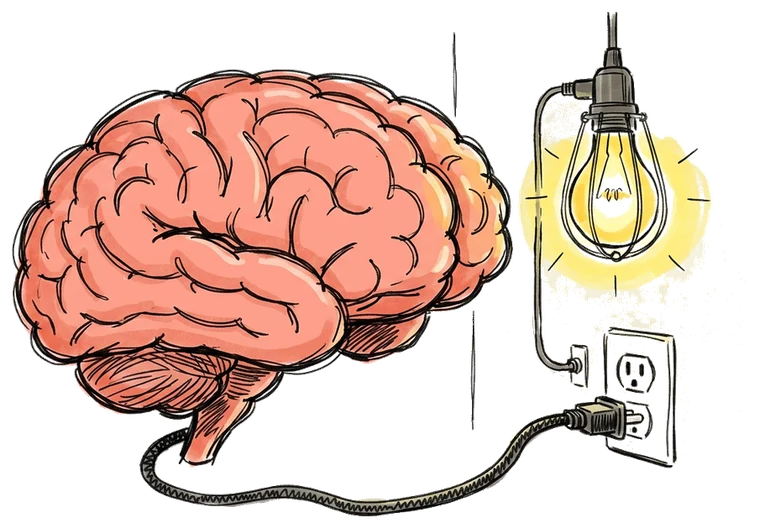
It sounds like science fiction. A strange claim from a movie. But that little three-pound lump of tissue between your ears is an electrical powerhouse, running day and night.
It’s true. Your brain generates about 20 watts of electrical power. That's enough to light up a dim, old-fashioned incandescent bulb. It’s not much, but it’s constant. Your own personal, biological power plant.
Where does the power come from? From your billions of neurons. Each one is a tiny biological battery. They fire off signals by pumping charged particles–ions–across their membranes. It's a massive, constant storm of electrical activity.
The Price of Power
This power isn't free. Your brain is 2% of your weight but eats a fifth of your calories–a furnace in a matchbox. The world is full of these quiet, amazing little engines. And taking a moment to see how they work is what we do here.
Every claim, checked
This is the whole list, including the ones we could not confirm. Verified means a checker confirmed it and named a source that exists. Wrong means both checkers said so. The rest failed in three different ways, and we say which. Not established: we checked and nobody could pin it down. No source: a checker backed it, but the citation did not hold up. Second check disagreed: the first reading confirmed it and the second one would not. Each line also says how the verdict was reached: searched means we went to the web to confirm the source exists, not searched means the verdict rests on what the checkers already know. The rest is in how we check things.
Your brain generates about 20 watts of electrical powerNot establishednot searchedStandard neuroscience reference. The human brain's metabolic consumption is approximately 20 watts; this power is dissipated primarily as heat and electrical activity. Source dropped: Kandel, Schwartz, and Jessell, Principles of Neural Science (5th ed., 2013) is not a study, an organisation or a reference work. Second checker: Estimates of the brain’s power consumption are commonly given around 20 W for a resting adult; this follows from the brain consuming ~20% of a 2000 kcal/day metabolism (≈400 kcal/day ≈ 19–20 W) and from detailed energy-budget studies of neural tissue. Source dropped: Attwell and Laughlin, Neuron (2001) energy-budget work; metabolic arithmetic bas is not a study, an organisation or a reference work.
That little three-pound lump of tissue between your earsVerifiedsearchedBritannica, Brain (human anatomy)
Your brain is 2% of your weight but eats a fifth of your caloriesVerifiedsearchedphysiology textbooks / review articles on brain metabolism (textbook values; examples in neuroscience literature)
That's enough to light up a dim, old-fashioned incandescent bulb.Not establishednot searchedOld-style incandescent bulbs are sold in low wattages such as 15–25 W for ‘night’ or small bulbs; ~20 W is within that ‘dim incandescent’ range, so a ~20 W power budget is comparable to a small incandescent bulb’s rated power. Source dropped: lighting specifications / incandescent bulb wattages (consumer lighting specific is not a study, an organisation or a reference work.
It's not much, but it's constant.Not establishedsearchedThe brain’s metabolic power consumption is continuous at rest and during wakefulness (basal neuronal activity continues constantly), so the power draw is essentially ongoing rather than intermittent like many appliances. Source dropped: no trace of textbook physiology / reviews of brain metabolism (resting-state brain on the web.
The power comes from your billions of neurons.VerifiedsearchedHerculano-Houzel, Frontiers/PNAS work on neuron counts (2009/2012); reviews of brain energy use
Each one is a tiny biological battery.Not establishedsearchedNeurons maintain membrane potential via ion gradients (Na+/K+ pump) and can be described as electrochemical cells; calling them ‘tiny biological batteries’ is a simplified but supported metaphor based on membrane potential and ion gradients. Source dropped: no trace of textbook on cellular neurophysiology (membrane potential and ion pumpi on the web.
They fire off signals by pumping charged particles–ions–across their membranes.VerifiedsearchedKandel et al., Principles of Neural Science (textbook); neurophysiology references
It's a massive, constant storm of electrical activity.Not establishednot searchedLarge-scale spontaneous activity and billions of action potentials and synaptic events occur continuously in the awake brain; imaging and electrophysiology show ongoing widespread activity even at rest. Source dropped: reviews of resting-state brain activity and electrophysiology (resting-state fMR is not a study, an organisation or a reference work.
People also ask
How much does the brain weigh?
The human brain is a relatively small organ. It is a three-pound lump of tissue.
How much energy does the brain use?
The brain is very energy-intensive for its size. It consumes a fifth of a person's calories despite being only 2% of their body weight.
How do brain cells create electricity?
Brain cells create electrical signals by pumping charged particles across their membranes. These particles are also known as ions.
One fact a week, drawn.
One email per video: the myth, what's actually true, and links to the research. No spam, unsubscribe in one click.