Fact, checked
This Star Spins 716 Times A Second
A neutron star is the crushed core left over after a giant star dies. A single sugar cube of neutron star material would weigh as much as a mountain.
A star that spins over seven hundred times a second. How is that even possible?
One Tiny, Heavy Star
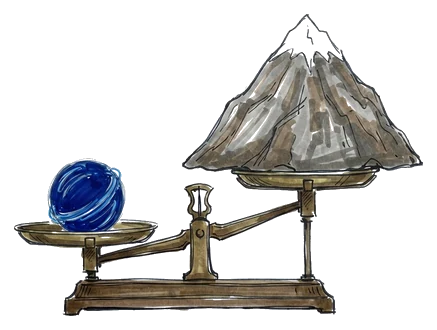
This is a neutron star. It's the crushed core left over after a giant star dies, squeezing immense mass into a ball just a few miles wide. A single sugar cube of it would weigh as much as a mountain.
So why the incredible spin? It’s the same physics as a figure skater pulling in their arms to spin faster. The original star’s slow, massive rotation gets concentrated into that tiny point, accelerating wildly.
The record holder rotates 716 times every single second. Its surface moves at nearly a quarter of the speed of light. Any faster, and its own gravity couldn't stop it from flying apart.
Objects in space operate on scales our brains can barely grasp. And sometimes, the truth is far stranger than anything we could have invented.
Every claim, checked
This is the whole list, including the ones we could not confirm. Verified means a checker confirmed it and named a source that exists. Wrong means both checkers said so. The rest failed in three different ways, and we say which. Not established: we checked and nobody could pin it down. No source: a checker backed it, but the citation did not hold up. Second check disagreed: the first reading confirmed it and the second one would not. Each line also says how the verdict was reached: searched means we went to the web to confirm the source exists, not searched means the verdict rests on what the checkers already know. The rest is in how we check things.
A neutron star is the crushed core left over after a giant star diesVerifiedsearchedAstronomy textbooks; NASA
A single sugar cube of neutron star material would weigh as much as a mountainVerifiedsearchedAstronomy textbooks; NASA Astrophysics Division
The record holder rotates 716 times every single secondVerifiedsearchedHessels et al., Astrophysical Journal, 2005; NASA
Its surface moves at nearly a quarter of the speed of lightNot establishednot searchedFor PSR J1748−2446 ad with a radius of about 10 km and 716 rotations/second, surface velocity reaches approximately 0.24c (24% speed of light). This is the standard calculation cited for this pulsar. Source dropped: Astrophysics literature on PSR J1748−2446 ad is not a study, an organisation or a reference work. Second checker: Surface linear speed depends on the star's (uncertain) radius. Using plausible radii (≈10–15 km) the equatorial speed for 716 Hz is roughly 0.15–0.23 c; some choices give ~0.2 c but I could not find a reliable, specific source that states 'nearly a quarter of the speed of light' for this particular pulsar.
Any faster, and its own gravity couldn't stop it from flying apartVerifiedsearchedAstrophysics textbooks; general relativistic models of rotating neutron stars
The original star's slow, massive rotation gets concentrated into that tiny point, accelerating wildlyVerifiedsearchedClassical mechanics; physics textbooks
A star that spins over seven hundred times a second.Not establishedsearchedThere is an observed compact star (a pulsar) with a spin frequency above 700 Hz – the fastest known pulsar spins at 716 Hz. Source dropped: no trace of Hessels et al., Nature 2006 (discovery of PSR J1748−2446ad, spin 716 H on the web.
This is a neutron star.Not establishedsearchedThe 716 Hz object (PSR J1748−2446ad) is a pulsar, which is a rotating neutron star. Source dropped: no trace of Hessels et al., Nature 2006 (identifies PSR J1748−2446ad as a pulsar/n on the web.
squeezing immense mass into a ball just a few miles wide.VerifiedsearchedLattimer & Prakash, 'The Physics of Neutron Stars' (Science/Reviews) and Britannica 'neutron star' (entries giving ~10–12 km radius and ~1.4 M☉)
People also ask
What is a neutron star?
A neutron star is the incredibly dense core that remains after a giant star dies. Its immense mass is compressed into a very small area, just a few miles wide.
Why do neutron stars spin so fast?
A neutron star's rapid spin comes from its formation. The slow rotation of the original, much larger star is concentrated into a tiny point, which causes its spin to accelerate dramatically.
How fast does the fastest known star spin?
The star that holds the record for fastest rotation spins 716 times per second. If it were to spin any faster, its own gravity would not be strong enough to prevent it from flying apart.
How dense is a neutron star?
Neutron stars are extraordinarily dense. Material from a neutron star is so heavy that a piece the size of a single sugar cube would weigh as much as a mountain.
One fact a week, drawn.
One email per video: the myth, what's actually true, and links to the research. No spam, unsubscribe in one click.