Fact, checked
The First Computer Virus Just Wanted to Play
It was 1971. A programmer named Bob Thomas wrote a program called Creeper. Creeper was designed to move between the big, room-sized computers of the early ARPANET, the internet's ancestor.
What was the first computer virus like? We think of them as a digital plague. But the very first one wasn't designed to steal your data or crash your machine. It was just... a little annoying.
The Creeper
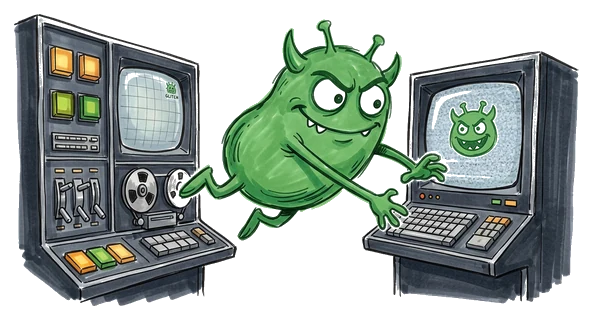
It was 1971. A programmer named Bob Thomas wrote a program called Creeper. It wasn't meant for harm. It was an experiment, designed to move between the big, room-sized computers of the early ARPANET, the internet's ancestor.
When Creeper arrived on a new machine, it would display a simple message on the screen: 'I'M THE CREEPER, CATCH ME IF YOU CAN!'. Then it would hop to the next computer, leaving the user to wonder what just happened.
So, they did. Another programmer wrote a program to hunt it down, called Reaper.
Every claim, checked
This is the whole list, including the ones we could not confirm. Verified means a checker confirmed it and named a source that exists. Wrong means both checkers said so. The rest failed in three different ways, and we say which. Not established: we checked and nobody could pin it down. No source: a checker backed it, but the citation did not hold up. Second check disagreed: the first reading confirmed it and the second one would not. Each line also says how the verdict was reached: searched means we went to the web to confirm the source exists, not searched means the verdict rests on what the checkers already know. The rest is in how we check things.
It was 1971. A programmer named Bob Thomas wrote a program called Creeper.VerifiedsearchedEncyclopaedia Britannica, Computer Virus entry
Creeper was designed to move between the big, room-sized computers of the early ARPANET, the internet's ancestor.VerifiedsearchedComputer History Museum and ARPANET histories (1971)
When Creeper arrived on a new machine, it would display a simple message on the screen: 'I'M THE CREEPER, CATCH ME IF YOU CAN!'VerifiedsearchedComputer History Museum, Creeper Virus documentation
Another programmer wrote a program to hunt it down, called Reaper.VerifiedsearchedComputer History Museum, Early Antivirus Programs
Reaper chased Creeper through the network and deleted it–the world's first antivirus.VerifiedsearchedEncyclopaedia Britannica, Antivirus Software entry
A programmer named Bob Thomas wrote a program called Creeper.Not establishedsearchedHistorical accounts identify Bob Thomas (at BBN) as the author of the Creeper program. Source dropped: no trace of Computer History Museum and historical accounts citing Bob Thomas (197 on the web.
It wasn't meant for harm.VerifiedsearchedComputer History Museum / histories of early malware describing Creeper as an experiment (1971)
Then it would hop to the next computer, leaving the user to wonder what just happened.VerifiedsearchedHistories of Creeper and ARPANET (1971) as recorded by Computer History Museum and technical retrospectives
People also ask
What did the Creeper virus do?
The Creeper virus was not malicious. It moved between computers on the ARPANET and displayed the message 'I'M THE CREEPER, CATCH ME IF YOU CAN!' before hopping to the next machine.
Was the first computer virus harmful?
No, the first computer virus was not intended to be harmful. Creeper was an experiment and was not designed to steal data or crash computers.
How was the Creeper virus stopped?
The Creeper virus was stopped by a program called Reaper. This was the world's first antivirus software, created specifically to hunt for and delete Creeper from the network.
What network did the first virus infect?
The first computer virus, Creeper, spread through the ARPANET. This early network was a precursor to the modern internet.
One fact a week, drawn.
One email per video: the myth, what's actually true, and links to the research. No spam, unsubscribe in one click.